The Starfish and The Spider: Introduction

The church that Jesus built was simple, reproducible, and flexible. You could kill one of its leaders and more would pop up in his or her place. Often times the persecution that came against the church would serve to strengthen it instead of kill it. This strengthening happened because in the way the church was structured, it was more like a starfish– You can rip of the arm of the starfish and not only would the arm grow back, but the starfish’s ripped arm would become a starfish of its own. There was power in being a simply structured organism that others fail to see.
This is where the book “The Starfish and the Spider” comes in. The authors begin the book detailing the quest to find the “Grandma Cell.” The quest for the Grandma Cell was one scientists went on to find which cells stored certain memories in the brain. They believed they would find that the memory of your grandma would be stored in every brain in a very specific place in multiple people’s brains. But what they found shocked them. Instead of the Grandma cell being stored in one place, they found memories stored in chains of cells distributed haphazardly across the brain. Not only were memories stored in more than one place, but more than one type of memory was stored in the same cell. It was a mess. The question was, “Why?”
The answer, as it turned out, was resiliency. Storing memories across different brain cells seemed inefficient in light of how we build computers, but memories stored this way across the brain protect it from memory loss. There’s not just one cell in the brain you could eliminate to take away someone’s memory of Grandma. You’d have to eliminate all the cells in the pattern. We think there is great safety in hierarchy, but sometimes simple, flat, even messy structures are the wise way to build something.
The book “The Starfish and the Spider” is about what happens when no one is in charge. Often times the hierarchy we think protects us makes us more vulnerable. It takes a look at a broad range of businesses, movements, and organisms that have no formal leadership structure and looks at how they succeed, even though no one believes that they will. As we’ll see, the things the authors learn as they go on their journey will have broad implications for how we “do” church.
More on that tomorrow…
Coming in October:
Okay….okay…I get it. It’s not as catchy nor anywhere near as intense as Shark Week. I mean, who in their right mind would try and top Shark Week? I did want to announce, though, that in October (one month from today) we will begin Starfish Month here at Pursuing Glory.
What’s Starfish Month, you ask?
Well, nearly nine years ago this October, I was part of a conference that was hosted by some dear friends in Kansas City. These friends had invited a long-time inspiration of mine, Wolfgang Simson, to come and share about what he felt the Lord was doing in the Earth. Wolf, as some of you know, wrote Houses That Change the World and at that time was putting the finishing touches on a new book that he eventually published himself called the Starfish Manifesto.
Houses That Change the World helped birth the idea of house churches in the hearts and minds of many early adopters within the house church movement. The Starfish Manifesto was kind of a next step. Where Houses was a micro level view of how churches should function, the Starfish Manifesto was the macro view of how a movement of house churches could reach the world for Jesus. It was next level thinking beyond anything I had come across at that point.
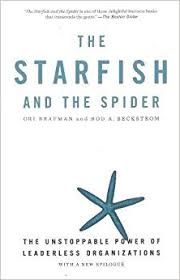 Also during this conference, I had the opportunity to spend a few minutes here and there chatting with Wolfgang. I remember him saying very firmly at one point that if we wanted to understand the true nature of what the Lord was doing in the church in that hour, we had to go and read a secular book called “The Starfish and the Spider” by Ori Brafman and Rod Beckstrom. When the conference was finished I hurriedly ran to my nearest bookstore and picked up a copy with a gift card I received. The book, which was all about the power of leaderless organizations, blew my mind and changed the way I’ve thought about the church ever since. Don’t let the fact that this is a secular book throw you. There is so much here gleaned from history and nature that you will quickly see the Lord’s inspiration in this book, whether the author’s meant it that way or not.
Needless to say, that month of October all the way back in 2008 was a formative year. Much of what came from that time formed the basis for what was to come as we worked to plant and raise up house churches here in Iowa. Every October, as the weather gets colder here, I look back sentimentally on that season and wish I could share it with you all. So, this October, I plan to do just that.
Starting Monday, October 2nd, I’m going to host a sort of book club here on the blog. Mondays and Thursdays in October I’ll share a brief synopsis of a chapter here on the blog with my thoughts on the content. Tuesdays and Fridays during October, I’ll take some of the thoughts and apply them to how they relate to the church. Throughout the week in October, I’ll also be sharing short excerpts from the condensed version of Wolfgang’s Starfish Manifesto, the Starfish Vision, on my Twitter feed. All of this adds up to us talking about how Jesus designed his church to function like a starfish.
Why am I telling you all now? To get you prepared, of course. First, I would love it if one or two of you joined me in re-reading “The Starfish and the Spider.” If that sounds interesting to you, now is the time to pick yourself up a copy of the book. You may also want to jump straight to Wolf’s Starfish Vision booklet and dive into what you find there. Regardless, I hope you join me in Reformation month reading and thinking about how there is still more reformation left ahead for the church and strategizing about how we can be part of it.
It’s not Shark Week…but it might just cause you to change the world.
Cluster Map

 Pursuing Glory