Coming in October:

Okay….okay…I get it. It’s not as catchy nor anywhere near as intense as Shark Week. I mean, who in their right mind would try and top Shark Week? I did want to announce, though, that in October (one month from today) we will begin Starfish Month here at Pursuing Glory.
What’s Starfish Month, you ask?
Well, nearly nine years ago this October, I was part of a conference that was hosted by some dear friends in Kansas City. These friends had invited a long-time inspiration of mine, Wolfgang Simson, to come and share about what he felt the Lord was doing in the Earth. Wolf, as some of you know, wrote Houses That Change the World and at that time was putting the finishing touches on a new book that he eventually published himself called the Starfish Manifesto.
Houses That Change the World helped birth the idea of house churches in the hearts and minds of many early adopters within the house church movement. The Starfish Manifesto was kind of a next step. Where Houses was a micro level view of how churches should function, the Starfish Manifesto was the macro view of how a movement of house churches could reach the world for Jesus. It was next level thinking beyond anything I had come across at that point.
 Also during this conference, I had the opportunity to spend a few minutes here and there chatting with Wolfgang. I remember him saying very firmly at one point that if we wanted to understand the true nature of what the Lord was doing in the church in that hour, we had to go and read a secular book called “The Starfish and the Spider” by Ori Brafman and Rod Beckstrom. When the conference was finished I hurriedly ran to my nearest bookstore and picked up a copy with a gift card I received. The book, which was all about the power of leaderless organizations, blew my mind and changed the way I’ve thought about the church ever since. Don’t let the fact that this is a secular book throw you. There is so much here gleaned from history and nature that you will quickly see the Lord’s inspiration in this book, whether the author’s meant it that way or not.
Needless to say, that month of October all the way back in 2008 was a formative year. Much of what came from that time formed the basis for what was to come as we worked to plant and raise up house churches here in Iowa. Every October, as the weather gets colder here, I look back sentimentally on that season and wish I could share it with you all. So, this October, I plan to do just that.
Starting Monday, October 2nd, I’m going to host a sort of book club here on the blog. Mondays and Thursdays in October I’ll share a brief synopsis of a chapter here on the blog with my thoughts on the content. Tuesdays and Fridays during October, I’ll take some of the thoughts and apply them to how they relate to the church. Throughout the week in October, I’ll also be sharing short excerpts from the condensed version of Wolfgang’s Starfish Manifesto, the Starfish Vision, on my Twitter feed. All of this adds up to us talking about how Jesus designed his church to function like a starfish.
Why am I telling you all now? To get you prepared, of course. First, I would love it if one or two of you joined me in re-reading “The Starfish and the Spider.” If that sounds interesting to you, now is the time to pick yourself up a copy of the book. You may also want to jump straight to Wolf’s Starfish Vision booklet and dive into what you find there. Regardless, I hope you join me in Reformation month reading and thinking about how there is still more reformation left ahead for the church and strategizing about how we can be part of it.
It’s not Shark Week…but it might just cause you to change the world.
Church as Family

This morning as I was scrolling through social media, I saw one of the people that I follow talk about how modern church is like a school and it should be more like a support group (think AA). Both of these are true statements. While I agree with both parts of this statement1, I believe the pattern for church was built on something much more ancient: family.
This shouldn’t surprise us. God is a Father and a Son in relationship with each other. Jesus emphasized the brotherhood of all believers (Matthew 23:8). This wasn’t just a term of affection, but a call to really act as brothers of a family. New Testament churches were often started in the homes of men or women of peace (see Luke 10:6) who would give a church planter an audience to his or her extended family. The spirit of family within each church would be greatly aided by the fact that most of the early members were part of the same family. Paul himself saw his apostolic ministry in the context of being a parent to the churches he planted (see 1 Corinthians 4:15, 1 Thessalonians 2:7). The church functioned first and foremost as a family.
I don’t think it’s surprising to most of us that the early church acted like a family. I think what surprises many is when churches today act as family towards each other. Often we pick other organizing principles, particularly those of business and education and structure our time around production and education instead of what builds us up as family.
So how does the church act as a family together?
They love each other. This starts with spending time together in a way the builds and facilitates relationship. There is plenty of time and space for relationships to develop, trust to form, and support to be given. Many times this love is expressed through serving each other in ways that reflect how Jesus has loved us and laid His life down for us.
Commitment is seen. Often church is seen as something that can be walked away from when it becomes inconvenient. If the teaching becomes stale, I’ll look for something better. If the worship becomes out-dated, there’s a more contemporary worship gathering down the street. But when churches act like families, the members don’t bail at the first sign of conflict or the opportunity to get a better experience. They commit to the bonds of love that the Lord has called us to.
There is mutual give and take. In every family, each member fulfills a roll of some kind. Rare is the family gathering where one member of the family does all of the talking. There is a back and forth kind of conversation that happens. Not everything everyone says in a family is of equal value. There are various levels of maturity, but conversation is the main method of learning and interaction and it produces well-rounded disciples.
There is growth and reproduction. Every family that doesn’t grow and reproduce will die off. I’m part of a large extended family in the natural, helping raise the fourth generation of Kolders that have come from the line of my Grandpa and Grandma Kolder. But each generation has had to grow up, move out of mom and dad’s house, and have little Kolders of their own. The same is true for the church. Family can seem safe, but there is a responsibility in family to step out, grow up, and pass on what you’ve received as part of your family to the next generation. Churches do this when they reach the lost, make disciples, and pass on the dynamic of Christianity as family to those they are discipling.
There is a lost generation of men and women all across our country. Not only are they far away from God, but they have a hunger in their heart for something they’ve never had: family. The answer starts when a person enters into a life-transforming relationship with God as their Father. It’s fully recognized, though, when a flesh and blood spiritual family adopt this new believer as one of their own. This is the reality that drives out the orphan spirit in us once and for all. To do that, the church may need to stop acting like a school or a business and devote themselves to becoming a family once more.
Photo Credit: Family by Randen Pedersen
1Church as we know it has largely adopted a meeting style from the educational system (one person teaching, rows of students, listening-based). Support groups such as AA have much to offer the church as a means for growing their body (high accountability, high intimacy, intentional mentoring, etc.).
More Than A Small Group…
Often when we meet other believers and they find out we meet in homes, they begin to tell us about their experiences in small groups that are part of their church experience. Often, I’m actually thankful for this, because I recognize that this is their way of trying to relate to what we do. It’s a bit of verbal and social hospitality that is an attempt to bridge the gap between what we do and what they do.
While I appreciate all of the kindness and I totally see some of the similarities (especially as they relate to size and group dynamics) I think it’s really important to point out that house churches are a bit more than small groups. Yes, they meet in homes like small groups. Yes, they are small groups of people, just like small groups. But that’s where the similarities start to end1.
House churches are a different animal because….
….they are responsible for extending the church in their relational networks and their region. They grow through evangelism and witness, not through attracting new believers from the larger church.
….they are spiritual families. They live life together and support each other, like families do. They are more than just a meeting once a week.
…they are responsible for each other. There’s no other immediate group of believers that will encourage, support, rebuke, love, or edify the members of a house church. It’s up to each house church to take care of the members of its body.
…the curriculum is the Bible. There’s no Bible study manual or teaching series spread around to the other house churches. The content that is produced results from each member’s time in the Word and relationship with the Holy Spirit.
…they don’t have a program. They are the program. Gathering together and following the Holy Spirit wherever he leads as He builds the church is the program.
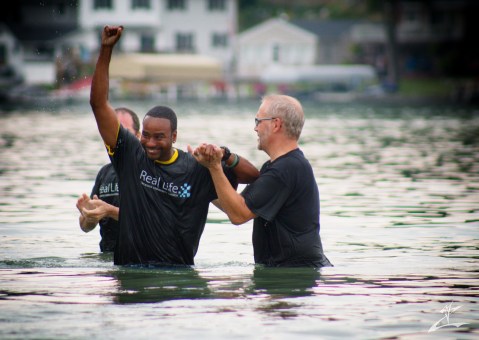
…they do what a church does. They devote themselves to the gospel, they fellowship together, they eat together, they pray together, they baptize new believers, they practice communion. Whatever a church does, they do.
Why is this important? Why the need for distinction? Clarity helps us pursue the right things. I want you to plant a house church, but you’ll take different steps to get to a house church than you would to start a small group. How you build up the church, make disciples, teach each other, and take communion will change depending on whether you believe your group is a church or just a short term collection of Christians who may be committed to other things.
So, are you part of a small group or part of something more?
Photo Credit: IMG_1205-Edit.jpg by MjZ Photography
Cluster Map

 Pursuing Glory