The Starfish and the Spider: Centralized or Decentralized

[Editor’s Note: If you’re just joining us, we are in the middle of reading through “The Starfish and the Spider” by Ori Brafman and Rod Beckstrom. Each Monday and Thursday I’ll summarize a few important principles from a chapter in the book. Each Tuesday and Friday, I’ll apply those principles to the starfish-shaped church I believe the Lord is building in the Earth.]
First, let me acknowledge that today is not Tuesday. Sorry folks, work and time with Jesus were priorities. Now, on to the breakdown of Monday’s chapter…
Chapter Two was really about the fact that we’re studying two different creatures: Spiders and Starfish. We mostly live in a world of spiders and because of that we find it difficult to spot starfish when we see them. They are so far out of what we consider normal that we miss them frequently. So the authors gave us a handy set of questions that show us the differences between decentralized organizations (starfish) and centralized organizations (spiders).
Within the chapter, the authors gave us a chart that showed the answers to these questions for two different organizations: One was a Spanish army, the other were the Apaches. As you might guess, the Spanish army functioned like a spider (it was highly centralized) and the Apaches functioned like starfish (they operated in a decentralized manner). It’s important to note that even these two groups weren’t pure starfish or pure spider, but they were certainly more of one than the other.
So, since today is the day where we look at how we apply these principles to the church, I thought I would take two different churches and place them in the matrix the authors designed. The first church I built a profile for is the first century church (or what we can observe of the first century church from Scripture). The second church I built was the modern institutional church. I’ll say this ahead of time: I was trying to be generous with both groups and not bring my bias into the equation. You will most likely disagree with me, but realize that I was trying not to over-generalize.
First up is the First Century Church:
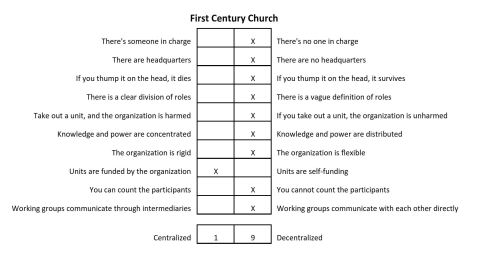
The first century church was very clearly a decentralized structure. There certainly was apostolic leadership, but it was only centralized for a very short period of time in Jerusalem and then through persecution and mission, it became difficult to find all of its leaders in the same city, much less the same room. Even then, there was no hierarchy or one individual who lead the church. There was no centralized headquarters for the early church. People often cite Jerusalem, Antioch, and Rome as the headquarters of the church, but the fact that it shifted throughout the span of the book of Acts tells us that there was no headquarters in the way we think of it today.
You could thump the early church on whatever you thought was the head, but the church wouldn’t die. Eleven of the twelve original apostles plus Paul were all killed for being witnesses, but the church only grew in their absence. You can try and argue there were clear roles, but Paul says he’s an apostle, a teacher, and evangelist/preacher (1 Timothy 2:7). Peter claims to be an apostle and an elder. Timothy, who is actually an apostolic worker was told by Paul to do the work of an evangelist. The roles certainly weren’t always clear.
Certainly you could take out a unit of the early church and the early church would still survive. The church in Jerusalem, for example, was devastated by the persecution that arose after Stephen’s stoning. The almost extinction of the church in Jerusalem (Acts 8:1) didn’t spell the end of the church. In fact, it marked the beginning of a great transition. Knowledge and power weren’t consolidated into the hands of the many. The New Testament is filled admonitions that we have the Spirit who will teach us (1 John 2:27) and that we all can be a part of the ministry of the Holy Spirit (1 Corinthians 14:26).
Obviously the organization is flexible. What Jesus started in Act 1 has grown so much by the time we reach Acts 6 that there is the need to raise up other servants. The persecution that begins with Stephen forces not just location changes but also the beginning of ethnic diversity. Obviously Luke struggles throughout the book to keep up with the numbers. At a certain point after the growth of the Jerusalem church, he just stops trying and starts using phrases such as “multiplied” or “many people were added to the church.” And we obviously see the various parts of the church directly corresponding to each other and not having to go through some kind of official channel.
The one area where I see the church acting somewhat more like a centralized organization within the New Testament is in the area of finances. There seemed in Jerusalem to be a common place to give (the apostles’ feet). Even later in Paul’s letters, you see him collecting money from the Corinthians and Philippians for missions work in other areas. This isn’t good or bad, it just is. There is rarely a pure starfish or pure spider and we see that playing out in front of us.
Now let’s look at the Modern, Institutional Church:

I’ll be brief here, because I think most of us are more familiar with this expression of the body than the prior example. I think there are times where the modern church has had it’s head thumped (a prominent leader dies or falls into sin, for example) and the people are invested enough in the church for it to survive. I think there are times where modern churches lose an arm or two and they survive. Very few churches control communication between members and between other churches.
As you can tell, though, there are large parts of the church that have become much more centralized. There is a clear human leader (usually called a pastor), a clear headquarters, ultra-clear roles, a high concentration of knowledge and power (seminary, ordination, etc.), rigid organization, a funding of the units by the organization (think cell groups or life groups, for example), and it’s very easy to count participants (they’re called members).
Many will argue that our times require us to be more centralized. I would disagree. I believe our times and the times we are about to move into require us to be more decentralized. It was this decentralized nature that allowed the early church to thrive even under the persecution of the Roman Empire. It’s the decentralized nature of the church in China that has allowed it to thrive as the Communists try to destroy it. Our centralization makes us a bigger, easier target. Our decentralization makes us leaner, harder to kill, and easier to spread.
I believe the church that Jesus founded was designed to spread and multiply and because of that we need to become more decentralized. We need to be more like a starfish and less like a spider…
Other Entries in this Series Include:
The Starfish and the Spider: Introduction
The Starfish and the Spider: Introduction II
The Starfish and the Spider: On Napster and Apache Leadership
The Starfish and the Spider: P2P Networks and Spiritual Nant’ans
The Starfish and the Spider: The Spider, the Starfish, and the President of the Internet
The Starfish and the Spider: The Spider, the Starfish, and the President of the Internet
[Editor’s Note: If you’re just joining us, we are in the middle of reading through “The Starfish and the Spider” by Ori Brafman and Rod Beckstrom. Each Monday and Thursday I’ll summarize a few important principles from a chapter in the book. Each Tuesday and Friday, I’ll apply those principles to the starfish-shaped church I believe the Lord is building in the Earth.]
The second chapter of the Starfish and the Spider introduces us to the book’s two main analogies: The spider and the starfish. These two animals will represent throughout the book to vary different approaches to organization. The spider represents a very centralized, controlled network. The starfish will represent a decentralized organization. This chapter will serve to highlight how you determine the difference.
Before we jump into spiders and starfish, there’s an amusing story at the beginning of the chapter worth highlighting: The President of the Internet. Dave Garrison was a newly hired CEO of an internet service provider (think AOL) named Netcom. Dave’s job as CEO was to pitch his company and recruit new investors. Remember in 1995 the internet was barely known about, let alone understood.
In one particular visit, Dave was in France explaining the concept of the Internet to a group of French investors. The conversation stalled when a question was posed: “Who is the President of the Internet?” This wasn’t an illegitimate question at the time. It was troublesome to invest money into an entity that had no system of accountability. We all know now that there is no president of the Internet, but at the time, the Internet was a risky gamble. Who would make decisions? Who would be held accountable? The investors assumed that the question kept getting lost in translation. Dave, on the other hand, knew better. After going around and around on the question, he finally gave up: “I am the president of the Internet.”
The story highlights a difficult problem when talking about Starfish and Spiders. Often it feels like we are living in a world full of centralized organizations. The world runs on a system of accountability and hierarchy, so much so that it can be difficult to spot a decentralized organization when you see it. The French investors mistook a starfish organization for a spider.
Within the book, Spiders represent centralized organizations. They may look like starfish in that there are legs that extend from a body, but that’s where the similarities end. The big difference between the spider and the starfish is the spider has a head. Cut off or crush the spider’s head and the spider dies, end of story.
Starfish on the other hand have what’s called a “distributed neural network.” There is literally no head nor is there a brain. You can’t behead a starfish. In fact, quite the opposite. Many types of starfish can be cut into pieces and the pieces can completely regrow into their own separate starfish.
The rest of the chapter spends time exploring the difference between these two types of organizations and there’s plenty that could be included. But for today, I want to sum up with a list of questions that Brafman and Beckstrom give us to understand whether we’re dealing with a starfish or spider organization:
Is there a person in charge? (Yes = Spider, No = Starfish)
Are there headquarters? (Yes = Spider, No = Starfish)
If you thump it on the head, will it die? (Yes = Spider, No = Starfish)
Is there a clear division of roles? (Yes = Spider, No = Starfish)
If you take out a unit, is the organization harmed? (Yes = Spider, No = Starfish)
Are knowledge and power concentrated or distributed? (Concentrate = Spider, Distributed =Starfish)
Is the organization flexible or rigid? (Rigid = Spider, Flexible = Starfish)
Can you count the employees or participants? (Yes = Spider, No = Starfish)
Are working groups funded by the organization or are they self-funding? (Funded = Spider, Self Funding = Starfish)
Do working groups communicate directly or through intermediaries? (Intermediaries = Spider, Directly = Starfish)
The important thing to remember is that no organization will typically answer all of these questions with the corresponding starfish or spider answer. There is a continuum where organizations fall. They do tend to be “more like a starfish” or “more like a spider” but it’s rare to be all spider or all starfish.
What does this mean for the church? We’ll look at that tomorrow…
Other Entries in this Series Include:
The Starfish and the Spider: Introduction
The Starfish and the Spider: Introduction II
The Starfish and the Spider: On Napster and Apache Leadership
The Starfish and the Spider: P2P Networks and Spiritual Nant’ans
The Starfish and the Spider: P2P Networks and Spiritual Nant’ans
[Editor’s Note: If you’re just joining us, we are in the middle of reading through “The Starfish and the Spider” by Ori Brafman and Rod Beckstrom. Each Monday and Thursday I’ll summarize a few important principles from a chapter in the book. Each Tuesday and Friday, I’ll apply those principles to the starfish-shaped church I believe the Lord is building in the Earth.]
Yesterday we spent some time looking at peer to peer (P2P) file sharing networks and how they were able to not just take on but thrive under opposition from large corporations like MGM. The secret, as Brafman and Beckstrom point out, can be found in the decentralized nature of the movement. They learned this from learning the history of Apache’s long fight against the Spaniards, who were a larger, more centralized army. The key to remember here is that decentralized movements, when attacked by larger and more centralized opponents, spread further and grow stronger.
So…how does this apply to the church?
First, the church of Jesus Christ is a peer to peer network. What does that mean? It means that Jesus encouraged us to look at each other as never being above another. He calls us in Scripture to mutual edification, mutual submission, and mutual sharing in ministry (1 Thessalonians 5:11, Ephesians 5:19-22,1 Corinthians 14:26). Jesus Himself told us that we should see ourselves as equals, not superior to each other (Matthew 23:8). Paul wrote the book of Romans to a group of believers who needed to hear his message, but also hoped to grow by receiving from their spiritual gifts (Romans 1:11-12).
This equality in Christ creates a peer to peer network that we call the church. As the church lives its life together and meets together for encouragement, giftings emerge that help form the body into the image of Christ (Ephesians 4:11-16). This happens on a micro level within individual churches but also on a larger level between churches. Each individual church relates to other existing churches as peers that help each other and encourage each other into the ways of the Kingdom. We see this in Scripture in the way the Antioch church takes up offerings for the church in Jerusalem (Acts 11) or the way in which the Philippians partner with Paul for the advance of the Gospel in other places (Philippians 4:14). All of this can and should happen without a person directing it, but by the leadership of Jesus through the power of the Holy Spirit.
Am I saying there’s no human initiative or leadership that happens within the church? Absolutely not. However, I think where we see leadership in Scripture, it is much more like the Nant’ans of the Apaches than the CEO of Starbucks or Walmart.
Who were the Nant’ans? They were spiritual and social leaders. They had the respect of those around them for their spiritual lives and for the wise choices they made. Apaches weren’t told what to do by the Nant’ans. Apaches decided to follow Nant’ans based watching their lives and seeing the outcome from it.
Who are the leaders in the body of Christ? It’s not those with a title that tell people what to do. It is those that have a true walk with Christ. They are those who give their lives to serving the body of Christ. Over a (short or long) period of time, the body sees the wise example in their lives and give themselves to following the examples of these believers (see Hebrews 13:7-8, 1 Timothy 3:2-7, 1 Corinthians 11:1).
Why is all of this important? Centralized leadership can cause a society to thrive. It certainly did for the Aztecs and the Incas and to a certain degree, it has worked for the legacy church. But take out a King or an Emporer and often the whole society falls apart. Over-dependence on centralized structures can look like a blessing until it’s not. How many mega churches have been devastated by the fall of their charismatic preacher? How many denominations with bishops and seminaries have fallen into grave heresy?
Most importantly, the testimony of our brothers and sisters in other countries tells us that a decentralized church not only survives under persecution–it thrives. Leaders can and are often jailed or killed. The decentralized nature of the church in those places allows for new leaders to step up into their place immediately. House churches that are split up because the threat of persecution multiply into more house churches and reach more people. They stay small enough to be undetected which means they stay small enough to care for each other like a family. Like a starfish torn in two that becomes two starfish, a church ravaged by persecution often multiplies into more than one house church. It’s why we say the blood of the martyrs is the seed of the church.
This decentralized nature of the church will take on more importance as we begin to understand the difference between starfish and spider organizations. These two are often at war with each other.
More on that on Monday…
Other Entries in this Series Include:
The Starfish and the Spider: Introduction
The Starfish and the Spider: Introduction II
The Starfish and the Spider: On Napster and Apache Leadership
Cluster Map

 Pursuing Glory