Reformation, Not Anarchy

I regularly encourage people to begin meeting in homes, encouraging each other, witnessing to lost people, and making disciples. I do this because I see it as the apostolic pattern in the New Testament. As I’ve encouraged people to take these steps, I’ve seen two very distinct responses: One group seems to submit more and more to Jesus and biblical truth, the other group throws out the baby with the bathwater.
Having watched people, this transition is hard. Tradition (buildings, sermons, clergy, etc.) rather than the Lordship of Christ has been what has “kept people in line” for most of their lives. This realization that the tradition doesn’t have the support of the New Testament can cause people to throw off all restraints, including God-ordained ones. So not only do they get rid of buildings, sermons, and clergy, but they throw out sound doctrine, Scriptural purity, any kind of spiritual discipline, and commitment to other believers. These are quickly ship-wrecked in their walk with the Lord, because they aren’t just getting rid of traditions, they are getting rid of Christ’s lordship over their lives.
Which brings us to the topic of anarchy. The idea of anarchy is borrowed from the realm of government. It means a society without a government or more specifically a land not ruled by a king. The Church for a long time has submitted to illegitimate heads (think the Pope or abusive evangelical leadership structures) but the cure for the church is not “losing its heads.” The cure isn’t anarchy. The cure for the church is recovering submission to its true head: Jesus Christ (see Ephesians 5:23).
Instead of anarchy, instead of calling believers to throw off all restraint, our task is to call men and women to submit to Christ more fully and express that in ways that grow ever closer to the pattern we see in Scripture. We’re not looking for anarchy. We’re looking for the true headship of Christ expressed in His body. This is more like a reformation, where the very operating system of the church is reformatted and brought closer to it’s original design, than a free-for-all where we can pick and choose what parts of the Gospel we like or not.
So let’s test our previous assumptions. But let’s test them, not in the light of “doing whatever is right in our own eyes,” (Judges 17:6) but in relationship to Christ’s Lordship that we understand through a diligent and faithful study of God’s word. Let’s submit to the Kingship of God and find life and power beyond our understanding. Let’s pursue a reformation of the church and the removal of illegitimate kings, but let’s not throw away the kingship. Let’s just give it to the Man who deserves it: Jesus.
How Billy Graham Would Have Lead A Church

Once, when asked what he would do as the pastor of a church in a city, Billy Graham shared this strategy:
I think one of the first things I would do would be to get a small group of eight or ten or twelve men around me that would meet a few hours a week and pay the price. It would cost them something in time and effort. I would share with them everything I have, over a period of years. Then I would actually have twelve ministers among the laymen who in turn could take eight or ten or twelve more and teach them. I know one or two churches that are doing that, and it is revolutionizing the church. Christ, I think, set the pattern. He spent most of his time with twelve men. He didn’t spend it with a great crowd. In fact, every time he had a great crowd it seems to me that there weren’t too many results. The great results, it seems to me, came in his personal interview and in the time he spent with the twelve.1
So, I’ll ask again…why aren’t you starting a house church?
1This quote is famously captured in Robert E Coleman’s important book, “The Master Plan of Evangelism.
So…Why Haven’t You Started A House Church Yet?
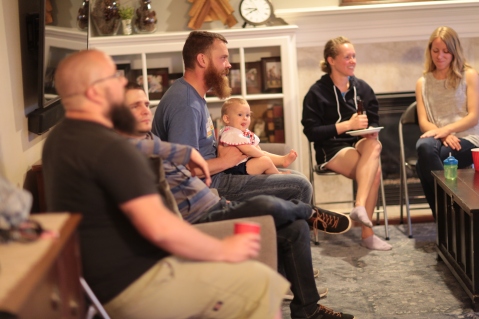
You may remember. You may not. You may be new around here. So, regardless of what group you fall in, let me take this moment and remind you: I want you to plant a house church.
That said, I thought I’d ask you a question. I know some of you have started and/or are part of house churches. My guess, though, is the majority of you are not currently part of a house church.
So what keeps you from starting a house church?
This isn’t a rhetorical question–I actually want to know! I really want to understand what stands in the way of everyday people who love Jesus from starting house churches among the lost. Is it fear? Are you being held back by another believer in your life? Are there struggles with your faith that are holding you back? Do you just not think house churches are important? Do you think that only apostles can start a house church? Is it none of the above, but something else?
I’d really like to know. My goal isn’t to expose you but to get a feel for what holds people back so we can all move forward, see more folks come to Christ, and see more house churches started.
So, what’s holding you back? You can leave a message in the comment section or you can email me at pursuingglory at gmail dot com.
Photo Credit: City Group O6-07-2017 by Parker Knight
Cluster Map

 Pursuing Glory