A Quick and Dirty Review of “Rising Tides” by Neil Cole

What It’s About:
Rising Tides is Neil Cole’s most recent published book that looks at four “rising tides” or trends in the Earth that are changing society and are changing the narrative for how and why we “do” church. Those four trends are rapid population growth, extreme technological innovation, growing economic disparity, and increasing political polarization. After discussing these four trends he spends the rest of the book talking about changes the church as a people must make to remain relevant in a society that is increasingly different than the one the church was so successful in reaching a generation or two ago.
What I Liked:
I’m a fan of Cole’s thought process and writing. Cole was one of my early influences in my process of starting house churches. Many of the societal factors Cole describes in his book and their impact on the church are reasons why I have chosen to meet and help give birth to house churches, so I found myself nodding, agreeing, and being encouraged about how he connected daily new stories and trends in the earth to the need for a church to be simple, reproducible, and real. Towards the end of the book, the themes come together in a very prophetic way that will present a picture of how the church must change.
Of all the books of Cole’s that I have read, this book is the most “end-time-like.” While Cole dances around the idea of end-times a bit, it’s clear he sees some of these factors pointing to a definitive point in humanity’s future. While he doesn’t exactly say we are living in the last days, he makes a solid case that history is heading towards a climax of some kind and we need to make an adjustment to endure the days ahead.
In many ways this book was much like a tract for those who might not be convinced by biblical reasoning to start an organic church but may be convinced by the need and the shifting atmosphere to adjust how the church is oriented. I love books that are more like tracts and as a “convert” it was a fun read.
What I Didn’t Like:
For those of us who have read “Organic Church,” “Organic Leadership,” “Church 3.0,” and some of Neil’s other books, there’s not as many new ideas here. If you’re like me, you’ve enjoyed all these reads and came for something maybe a little fresher. There is some of that, but most of the fresh material relates to the trends affecting us currently. It’s not that these sections were bad, but they weren’t really a surprise. There was maybe a new idea every chapter or two, but much of what was found here was repackaged from some of Cole’s other works. This isn’t a problem if you’re new to Cole’s work, but for someone familiar it served mostly as a good refresher.
The other thing I struggled with was the book seemed to raise the four “rising tides” as shifts the church needed to address, but the solutions seemed to still be forming in Cole’s mind. It wasn’t that they were bad ideas–most of the problems presented by the rising tides Cole addressed with the answer of a more organic, reproducing church. Again, here I agree, but in some ways these ideas didn’t seem robust or well connected to the problems. The one Cole most thoroughly covered was how a multiplying church could keep up with population growth, but with the tides of technological innovation or economic disparity the connections to his solution were less clear. Cole himself admitted this book was written quickly in order to not become out of date and it may be that some of the ideas needed a little more time to develop.
Should You Get It:
If you’ve never read a book by Cole, I would strongly suggest it. Cole loves the church and he writes a love letter to the church begging her to recognize the times she’s living in. Once you’ve read this book, I would strongly suggest you pick up a copy of Church 3.0 or Organic Church to further explore the ideas he suggests within this book.
If you love Neil, have heard him speak a lot, or kept up with his other books, I would be a little more wary. Unless you have a need to read every book of his or haven’t thought much about how house churches keep up with an ever-changing society, this might be a redundant book.
Rating:

Photo by Sharon McCutcheon on Unsplash
Coming in October:

Okay….okay…I get it. It’s not as catchy nor anywhere near as intense as Shark Week. I mean, who in their right mind would try and top Shark Week? I did want to announce, though, that in October (one month from today) we will begin Starfish Month here at Pursuing Glory.
What’s Starfish Month, you ask?
Well, nearly nine years ago this October, I was part of a conference that was hosted by some dear friends in Kansas City. These friends had invited a long-time inspiration of mine, Wolfgang Simson, to come and share about what he felt the Lord was doing in the Earth. Wolf, as some of you know, wrote Houses That Change the World and at that time was putting the finishing touches on a new book that he eventually published himself called the Starfish Manifesto.
Houses That Change the World helped birth the idea of house churches in the hearts and minds of many early adopters within the house church movement. The Starfish Manifesto was kind of a next step. Where Houses was a micro level view of how churches should function, the Starfish Manifesto was the macro view of how a movement of house churches could reach the world for Jesus. It was next level thinking beyond anything I had come across at that point.
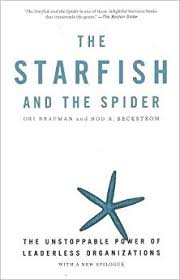 Also during this conference, I had the opportunity to spend a few minutes here and there chatting with Wolfgang. I remember him saying very firmly at one point that if we wanted to understand the true nature of what the Lord was doing in the church in that hour, we had to go and read a secular book called “The Starfish and the Spider” by Ori Brafman and Rod Beckstrom. When the conference was finished I hurriedly ran to my nearest bookstore and picked up a copy with a gift card I received. The book, which was all about the power of leaderless organizations, blew my mind and changed the way I’ve thought about the church ever since. Don’t let the fact that this is a secular book throw you. There is so much here gleaned from history and nature that you will quickly see the Lord’s inspiration in this book, whether the author’s meant it that way or not.
Needless to say, that month of October all the way back in 2008 was a formative year. Much of what came from that time formed the basis for what was to come as we worked to plant and raise up house churches here in Iowa. Every October, as the weather gets colder here, I look back sentimentally on that season and wish I could share it with you all. So, this October, I plan to do just that.
Starting Monday, October 2nd, I’m going to host a sort of book club here on the blog. Mondays and Thursdays in October I’ll share a brief synopsis of a chapter here on the blog with my thoughts on the content. Tuesdays and Fridays during October, I’ll take some of the thoughts and apply them to how they relate to the church. Throughout the week in October, I’ll also be sharing short excerpts from the condensed version of Wolfgang’s Starfish Manifesto, the Starfish Vision, on my Twitter feed. All of this adds up to us talking about how Jesus designed his church to function like a starfish.
Why am I telling you all now? To get you prepared, of course. First, I would love it if one or two of you joined me in re-reading “The Starfish and the Spider.” If that sounds interesting to you, now is the time to pick yourself up a copy of the book. You may also want to jump straight to Wolf’s Starfish Vision booklet and dive into what you find there. Regardless, I hope you join me in Reformation month reading and thinking about how there is still more reformation left ahead for the church and strategizing about how we can be part of it.
It’s not Shark Week…but it might just cause you to change the world.
New Testament Church Planting

The conversation happens so often you can almost predict how it’s going to go. Someone who the Lord has just started speaking to about organic church or house churches logs onto a house church discussion group and they ask this question: “What’s the best book out there on organic church?” People will begin to suggest the staples: Books by Neil Cole, Frank Viola, Jon Zens, etc. I’ll throw my two cents in and suggest my top five books on house churches. But inevitably someone will suggest the book of Acts.
Now, I’m never sure if someone is serious when they suggest the book of Acts or whether they are being a bit tongue in cheek to highlight peoples’ tendencies to rely on current authors over God’s word. Sometimes I think they’re doing both. Inevitably, though, someone will recommend the book of Acts as the book to read if you’re wanting to plant house churches.
This conversation happened again today on Facebook and it got me thinking about how we treat the New Testament in regards to church planting. Obviously we have a lot to learn from the book of Acts, but I found myself a little sad today because no one recommended the books of First and Second Timothy or Titus or the Gospels or the Minor Epistles. There is so much to learn from the New Testament that aids us in our pursuit of the church God wants, that to only learn from the book of Acts would be a travesty.
How do the books of the New Testament apply to house church planting? In so many ways. Here are a few:
Matthew, Mark, Luke, and John
It should go without saying, but the Gospels are critical to the success of any house church. Without the story of Jesus’ perfect life, atoning death, powerful resurrection and ascension into Heaven, none of what we do as house churches makes any sense. Not only are we redeemed by the good news we find in the Gospels but we are matured by the good news we find there. We are designed to grow up into the image of Christ (Ephesians 4:15), so we must constantly hold in front of us the image of Christ, not the New Testament church, so we can grow up into His likeness.
Acts
So based on my previous statements this should be a no-brainer. The book of Acts shows us how the small, struggling group Jesus left behind became a nearly unstoppable missionary force. We’d do well to learn from the apostles and others we see in the book of Acts and adopt many of their principles. If anyone tells you the book of Acts is descriptive but not something we should base our churches or strategy on, remind them that all Scripture is inspired by God and useful for teaching, reproof, for correction, and for training in righteousness (2 Timothy 3:16), including the book of Acts.
Paul’s Epistles
Paul wrote the books of Romans through the book of Philemon. There is so much good in all of these books that I could go on for a long time, but I’ll focus on two aspects.
Some of Paul’s books feature rich and deep theology. Romans, Galatians, Ephesians, Philippians and Colossians fit into that category. While each of these books have some stunning pictures of body life, they come after an unveiling of who Christ is in His resurrected glory. Understanding Jesus as the exalted Son of God is critical to house churches functioning as Kingdom outposts.
The other books Paul wrote–1 Corinthians, 2 Corinthians, 1 Thessalonians, 2 Thessalonians, 1 Timothy, 2 Timothy, Titus and Philemon are much more practical books. If the earlier books paint you a picture of the resurrected Jesus, these books paint a picture of what the practical early church movement looked like. Many of these books are Paul trouble-shooting church problems that crept in in his absence because of the highly mobile ministry we see him operating in in the book of Acts.
One final note on Paul’s contributions. Everyone who believes that Acts is a blueprint for what the Lord wants to do through house churches needs to spend serious time in 1 Timothy, 2 Timothy, and Titus. These books describe Paul trying to finish what he started in his missionary journeys but didn’t have time to fully complete. I know many people who pit Acts style church planting vs. “Pastoral Epistle” style churches. In reality, Paul planted churches like he did in Acts and served them from a distance by writing books like 1 Timothy and Titus. The churches planted in Acts wouldn’t have survived without the wisdom we find in those books.
General Epistles
These books were written by other early church leaders besides Paul. They include the books of Hebrews, James, 1 Peter, 2 Peter, 1 John, 2 John, 3 John, and Jude. I love these books and think they are incredibly relevant to house churches and here’s why: Most of these books were letters written to house churches struggling with false teachers who have entered into their midst. You may have not struggled with false teachers, false prophets, or false apostles having come to your house church yet, but if you meet organically for any length of time you will. Often our response to false teachers is to elevate good teachers, but the apostles wrote these letters to encourage the church to contend with false teachers without becoming institutional. This is such a critical reality that we all need to learn from on our journey to becoming the church God wants.
Revelation
Finally, we come to the book of Revelation. Many of you will disagree with me and that’s okay, but I’m still firmly of the opinion that the book of Revelation should be read literally. I still believe that the second coming of Jesus is our hope in this age and the events described within the book are to prepare us for the hour before the Lord’s return. This movement of finding God’s heart for His church, for reaching lost people and discipling them, and for multiplying disciples and churches is going somewhere and I believe that somewhere is the literal return of Jesus to reclaim the Earth. This book serves us by teaching us not to give our hearts to world and its systems and that message will be more and more critical as the day draws nearer.
Conclusion
Imagine a church that is rooted in the Gospel, planted and established like the churches in the book of Acts, guided by Paul’s fascination with the risen Christ and the wisdom he had acquired through planting tens of churches. Picture this same church knowing how to deal with false teachers that show up in their midst and who are prepared, not just for the end times, but for the Kingdom Jesus is bringing on the other side of those end times.
This is the church Jesus is building. It will take the whole counsel of Scripture in order to produce it. It will require us to ask Jesus to give us a spirit of wisdom and revelation in the knowledge of Him. But if we read our Bibles with our hearts open before the word, we will be stronger house churches for it.
So what’s my favorite book on organic house churches?
Let’s start with the New Testament.
Photo by Jonathan Simcoe on Unsplash
Cluster Map

 Pursuing Glory