Zoo Christianity
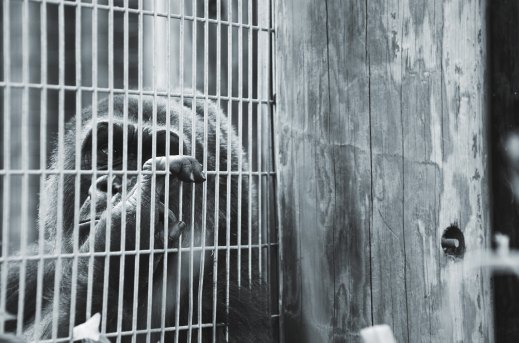
One of the things I think we all love about zoos it the ability to see animals many of us would never be able to afford to see in the wild. Most of us would never seen a tiger, hippo, or a monkey in real life. Zoos bring the animals to us and allow us to capture the exotic nature of a wild safari without the danger or the cost.
One of the things I think we would all acknowledge about zoos, though, is that the animals we love to see in them are rarely as full of life as they are in wild. On a recent trip to a zoo with my family, we stopped to look at the lions. There were three of them laying on the ground, sunning themselves. My wife leaned over to me and whispered, “I don’t know how many times I’ve been to a zoo and every time they look exactly like this.” Animals that are fed, caged, and have their every need cared for rarely have the spark of life that we think of when we picture an animal in the wild.
My wife’s comment reminded me of a trip to Africa several years ago. In the midst of different wings of our ministry trip, we had a down day for rest and recuperation. Our contact asked what we wanted to do that day. I told him I wanted to see a giraffe or a hippo. He got a delighted look on his face and said, “We can go to the zoo!” I quickly shot back, “Paul, this is Africa. I don’t want to go to the zoo!” I wanted to see what the animals operating like God designed them.
Often, Christians live in cages, too. These are cages of their own making. They are regularly “fed.” They have all their needs met. In these cages, they are safe to do everything Christians do. People from the outside can even come in and look at what Christians are and what they do.
The question is, like the monkey or the lion that has lost his spark in the zoo, have you lost your spark? Have you settled for less than what God has intended for you? Maybe it’s time for Christians to venture out into the wild and learn what it means to feed themselves and function without the cage. You might be surprised what a Christian released into their natural habitat is capable of.
The Starfish and the Spider: What Craigslist and Burning Man Teach Us

[Editor’s Note: If you’re just joining us, we are in the middle of reading through “The Starfish and the Spider” by Ori Brafman and Rod Beckstrom. Each Monday and Thursday I’ll summarize a few important principles from a chapter in the book. Each Tuesday and Friday, I’ll apply those principles to the starfish-shaped church I believe the Lord is building in the Earth.]
“A Sea of Starfish” was the book’s attempt to give us a number of contemporary examples of starfish organizations to better get our minds around the possibilities of decentralized organizations. Skype, Craigslist, Apache, and the Burning Man festival were all profiled in order to highlight how decentralized organizations can operate without being chaotic. While all of these are “secular” organizations1, the underlying lesson this chapter teaches has much to say about how we can be faithful to how God designed the church.
The one key principal that allowed for these groups to thrive without a centralized leadership is what the authors call an “open system.” In an open system, an organization is established where everyone is allowed to participate. There is an implicit trust in the participants that they will mutually care for the group and participate in its health. Many of the decisions for open systems are decided by the participants themselves and not by a leader or an executive committee. In an open system, care for the members isn’t directed by a leader, but by other members as they see needs.
Imagine a church that operates like this. A church as an “open system” would have meetings where everyone who came could and should participate (1 Corinthians 14:26). It would trust the ministry that is often expected of one person to the whole body (Romans 12:4-8). I have to believe that such a church would continually emphasize the “one anothers” of Scripture. It would put the church in the hands of the church and in so doing, put it in the hands of Jesus.
This church wouldn’t necessarily exist without leadership. First, and primarily, each member would be individually submitted to Jesus and operate out of that submission. He will act as the true leader in the midst of such a church, orchestrating a grander plan than any of us could imagine. Because the church is an open system, mutual accountability to each other in light of Christ’s Lordship would be practiced (Ephesians 5:21). Any time a believer began to operate outside of submission to Jesus, one member within the church would correct the other. Members within this open system that are known for their submission to Jesus over time would even be given authority to protect the system but not control it (1 Peter 5:1-5, Acts 14:23, James 5:14).
This type of church is possible, but it is also messy. We get skittish the first time someone who isn’t “trained” addresses the group or they speak for way too long. The first time heresy is taught by someone within the group, we start to want to go back to the good old days. People with messy lives will be seen more often and those who are a bit more mature may be seen less. Over time, however, a church like this would grow together. They would learn how to love each other, bear with one another, correct each other in love, and everyone would gain a greater appreciation for the lordship of Christ and the truth of the Bible.
This type of “open system” church is possible, but we need to be able to embrace “the mess.” God is a God of order, for sure, but His order looks more like a forest or an ocean than like graveyard where everything is in rows. The life it produces is infinitely more valuable than predictable “meetings” with very little life. We have to trust that Jesus is able to lead every member of His body, not just a select few.
Open system churches are possible. They are biblical. They exist. What’s stopping you from being part of one?
Or even better, what’s stopping you from starting one?
1The Burning Man festival is especially not known for being a center of righteousness. While I can’t endorse everything that goes on there, I want to point out that Jesus specifically found examples of the Kingdom in every sphere of society, especially in places the religious elites never would have assumed it could be found. This is where we have to be very careful to eat the chicken and spit out the bones.
Other Entries in this Series Include:
The Starfish and the Spider: Introduction
The Starfish and the Spider: Introduction II
The Starfish and the Spider: On Napster and Apache Leadership
The Starfish and the Spider: P2P Networks and Spiritual Nant’ans
The Starfish and the Spider: The Spider, the Starfish, and the President of the Internet
The Starfish and the Spider: A Sea of Starfish
[Editor’s Note: If you’re just joining us, we are in the middle of reading through “The Starfish and the Spider” by Ori Brafman and Rod Beckstrom. Each Monday and Thursday I’ll summarize a few important principles from a chapter in the book. Each Tuesday and Friday, I’ll apply those principles to the starfish-shaped church I believe the Lord is building in the Earth.]
Today’s chapter focuses on five very different types of organizations that operate as decentralized entities. These organizations thrive by “checking” the decentralized side of the questionnaire we looked at yesterday, even though they are all very different.
Brafman and Beckstrom looked at Skype, Craigslist, Apache, Wikipedia, and the Burning Man festival. Each of these has a little different story: Skype started as the brainchild of one of the peer to peer file sharing site creators. He decentralized calling long distance. Craigslist started as a community of people looking to help, trade, and sell to one another that ended up shaking the newspaper industry. Apache began as a group of like-minded computer engineers who began to build patches for the Internet. As they began to take themselves more seriously, everyone else did as well and they began to create open-source technology that challenges the spider-like tech companies of the world. Wikipedia began as a failed online encyclopedia that turned the role of content creation over to its users. Lastly, the Burning Man festival is the example of a real world (albeit temporary) community with no rules and no exchange of money that somehow maintains some sense of cohesion.
Each of these organizations have an interesting story of how they arrived at being starfish-like organizations, but they all have one trait in common–they put people in an open system. Open systems are systems where each member of the community can interact and contribute others in the community. No intermediary or expert is needed, simply a willingness to contribute and a trust in others within the system to similarly contribute. Craigslist, Wikipedia, Apache, and even those at the Burning Man festival all trust that others around them will help fill in the gaps that others missed. It’s what makes something that should be chaotic somehow work.
There are tremendous implications in this for the church. We’ll look at those tomorrow…
Other Entries in this Series Include:
The Starfish and the Spider: Introduction
The Starfish and the Spider: Introduction II
The Starfish and the Spider: On Napster and Apache Leadership
The Starfish and the Spider: P2P Networks and Spiritual Nant’ans
The Starfish and the Spider: The Spider, the Starfish, and the President of the Internet
Cluster Map

 Pursuing Glory