Apostolic Christianity (The Series)

The church in the West is at a crossroads. Beset on every side by dangers from the outside (political and social pressure) and dangers on the inside (immorality, legalism, heresy, etc.), it’s become increasingly clear that we cannot remain where we are and be faithful to Jesus, let alone be effective….Instead of going left, right, or beyond, we have the option of going back. Going back, you ask? Go back to what? The answer is to go back to the original design Jesus has for His church. The design is not complicated, it is not hidden, but it is often neglected. When we return to Christ and His original design for His church, powerful things begin to happen… This design for God’s church is what I call “apostolic Christianity.”
And with that, I began the first of a series of posts describing what I believe is apostolic Christianity. These posts started being written in 2014 and have only finally all been written and posted. You can find the complete collection of apostolic Christianity articles below:
Apostolic Christianity (Part One)
Touching the Bones of the Apostolic Church (Part Two)
Apostolic Christianity: What It Is (Part Three)
A Short Primer on Apostolic Ministry (Part Four)
The Apostolic Nature of House Churches (Part Five)
Photo Credit: Jesus by Curtis Perry
The Apostolic Nature of House Churches
[Editor’s Note: This article is part of five of a five part series addressing the nature apostolic Christianity. You can read the earlier articles starting here.]
Christianity in the West is in transition. I’ve argued in a previous post that instead of the church moving right, left, or beyond, the way forward is to go back. We need to embrace a model of Christianity that, if seen by the apostle Paul or Peter, would be recognizable to them.
I could make a list of areas the church looking to embrace a more apostolic nature should pursue. (I have, here.) But whenever a return to apostolic Christianity is contemplated the element that regularly gets overlooked is the idea of structure. It’s almost as if the way in which the church lives its life together, strengthens itself, and reproduces itself doesn’t matter. This is the farthest reality from the truth. How the church lives life together ultimately either strengthens and enhances the “apostolic lifestyle” that we’ve been talking about or it wears on it and slows us down on our journey toward it.
There is a design to the way God builds his church. To the degree that we deviate in practice from what Scripture describes of the church, to that degree we work against ourselves in our aim for true, apostolic Christianity. A mere push for the Lordship of Jesus, the power of the Spirit, the evangelistic heart for the lost, a commitment to continue in the face of suffering, and a view of Jesus’ return without a change in church structure that will sustain that lifestyle will find the people inside it frustrated. New wine in an old wineskin is a disaster waiting to happen (Luke 5:36-39).
The particular wineskin I’m advocating for in this space is what is traditionally known in the west as a house church. In the New Testament it was known as “the church that meets at so-and-so’s house.” This particular way of gathering together is important because it was the context that apostolic Christianity was birthed out of in the New Testament. It was the soil that the first century church sprouted out of and it empowered the church to grow both deep and wide across the Roman Empire and beyond.
Much has been written about house churches and why they are important. Book after book tells you what they are and how to start them. Instead of retreading old ground, I want to look at why the house church model is apostolic in its nature. There was a reason why the apostles traveled around starting churches that met in homes. Many assume it was because they were persecuted and unable to meet openly. But in reality, there was a design to the church that sustained a certain type of life and it’s this type of life that we desire.
To be as clear as possible, there’s nothing magical about house churches. They will never replace submission to Jesus or the power of the Spirit. But because they are the way Jesus founded His church, they are an outgrowth of Jesus’ Lordship that our response to can either hurt or hinder our journey towards apostolic Christianity. Apostolic Christianity grows better in the soil of house churches because they are apostolic in nature. And it’s this apostolic nature of house churches I want to explore.
What would cause Jesus, the apostles, and the apostolic church of the first and second centuries to start fellowships in the homes of believers? The easy answer is persecution. And yes, persecution played a part in that decision. But if you look deeper, there were spiritual realities that these small gatherings empowered that were in their very nature apostolic. The apostolic church of the first and second centuries planted churches because they were simple to establish and replicate, they allowed for the Gospel to spread quickly, and they enabled the church to minister and care for itself.
Simplicity
It takes very little to start a house church. Two or three believers that gather together to eat, read God’s word, pray, and encourage each other are the beginning of a church. They can meet anywhere at any time. They don’t need trained seminarians to lead them or any kind of org chart. They exist without much structure in order for the life of Jesus to be the focus.
This isn’t to say that house churches are simplistic. They will still have problems and struggle. But I can talk new believers through how to start house churches over the course of a day or two. These new believers will need a Bible and some encouragement along the way. They might even need someone to bounce things off of from time to time. But they can be a legitimate church with some basic instruction and a true commitment to Jesus. It’s why Paul could plant a church after only being in a place for a short time.* This is possible because it’s the believers’ connection to Jesus that support the church, not the worker.
I believe the simplicity of the early church was intentional. It allowed the church to be lead by “ordinary men with no special training in the Scriptures” who may not have been “wise in the world’s eyes.” As the architects of the church, the apostles knew that a simple structure would allow it to function properly among the people it was intended to reach.
The Gospel Spreads
It was this simplicity of structure that allowed for the unprecedented spread of the Gospel. Churches could be planted as quickly as people came to Christ. When a new group of people would come to Christ in another relational network, another part of town, or even another city, they would be the beginning of a new church. They wouldn’t even need elders to be considered legitimate. Frequently elders would be raised up from within a church as those with wisdom and character were identified by apostolic workers (Acts 14, 1 Timothy 1).
With this simple method of producing churches, Gospel outposts cropped up, first in the major cities of the Roman Empire and then moved out into the towns and villages. Unburdened from unbiblical, complex systems, the church spreads. Tony and Felicity Dale share this simple analogy: If you put two elephants in a room together and close the door, in 22 months you may get one baby elephant. But two rabbits together for the same amount of time will result in thousands of baby rabbits! The difference lies in how complex of an organism is being made. Simplicity of structure allows for churches to rapidly reproduce through the spread of the Gospel.
This was crucial to the early apostolic church. Filled with restless gospel exporters, the early church planted house churches that allowed the Gospel to move as quickly as possible through a region. Quickly apostles (especially Paul) would consider a region “reached” if they started one or more house churches there (see Romans 15:19). They knew that the seed of one house church would eventually grow, multiply, and cover a region.
Ministry and Care for Itself
Once established, apostolic church planters would leave to spread the Gospel to another region. But their nature as spiritual parents and architects of the church caused them to care about what happened to the churches they started when they left. They weren’t abandoning their spiritual children, but moving on to another place to raise more. It became important for the church to be able to nurture and take care of itself in the absence of these workers.
Because the churches they started were organic in nature, they were built around the presence and person of Jesus, not around programs or meetings. This allowed even the newest believer to participate in the life of the church. Paul describes this dynamic in 1 Corinthians 14:26. As believers looked to Christ to lead their gatherings, the Holy Spirit would give members of the church different gifts, all for the building up of the body. This is why Paul says in Ephesians that “when each part is working properly, [it] makes the body grow so that it builds itself up in love,” (Ephesians 4:16).
This dynamic would allow the apostolic worker to continue to move, entrusting the fledgling church to Jesus (Acts 14:23), knowing the church would continue to spontaneously build itself up as it met together in the overflow of His power. The apostles continually encouraged the churches to practice “one anothers,” means of taking care of each other and showing love that lead to the body being strengthened. This enabled the priesthood of believers to be lived out (not just believed) among the early churches.
Conclusion
It’s my belief that the apostles learned how to live in missional community from Jesus. As an apostolic band, He taught them how to relate to the Father, love one another, and declare the Gospel of the Kingdom. He didn’t just show them the way, He was the Way. And it was this “Way” that the apostles used to start churches first in Jersualem, then in Samaria, and then in places like Antioch, Ephesus, and Rome.
The apostles didn’t start churches in the same way that church is traditionally practiced in the West. They started simple churches that met in homes. This wasn’t simply a response to persecution. It was a conviction that the church be simple, help spread the Gospel, focused on Jesus, and would take care of each other. The result was an apostolic movement made up of house churches.
House churches are apostolic if we let them be. I’ve seen some very non-apostolic house churches. But rightly oriented, house churches serve not just as an alternative to churches that meet in buildings, but as a means of strengthening the apostolic objectives of the church.
The church in the West is at a crossroads. It’s not enough for us to go left, right, or even beyond. We have to go back to Christianity as it was taught and practiced by the apostles who learned from Jesus. This will require not just a return to biblical principles of meeting, but to the truth of Christ and His Kingdom as we’ve been discussing in other posts. But Christ calls us to put new wine into a new wineskin. Living out apostolic Christianity will need to take place in an apostolic structure, both of which the apostles learned from Jesus.
If we return to apostolic Christianity in both it’s content and it’s practice, we will begin to get to a place where the wine and the wineskin work together. The form of the church supports the church growing in the message of Jesus and spreading the Gospel of the Kingdom. And the result of this will be something the world has seen only a very few times in history.
Will you join me on this journey?
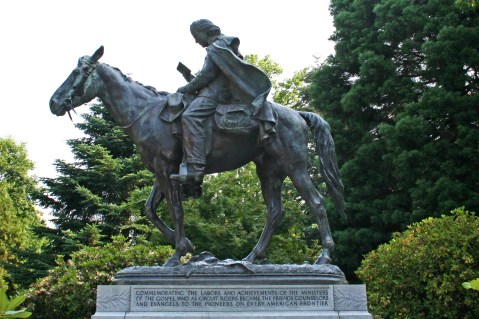
Photo Credit: 268d circuit rider sculpture mod by alfromny@sbcglobal.net
*Paul stayed in Thessalonica for roughly 3 weeks according to Acts 17:1-10. We can’t say how long he stayed in Berea, but it seems it was only as long as the antagonists from Thessalonica didn’t know about him being there. Many places don’t tell us how long Paul stayed in a place, but his longest stay was two years and three months in Ephesus. And while persecution was obviously a factor, Paul was incessantly nomadic because he was determined to keep pressing into areas where the Gospel had never been (Romans 15:20-24). Regardless of Paul’s length of stay, it’s obvious Paul spent much less time starting churches than most people in traditional church planting do. The simplicity of house churches aids this considerably.
A Short Primer on Apostolic Ministry
 Over the last sixteen years or so, I’ve been on a journey to understand how Jesus builds His church.
If this feels like a strange pursuit, understand that I believe Jesus builds His church in a much different way than we think. Church As We Know It (CAWKI) is much different than Church As God Wants It (CAGWI). There is a difference between the church that exists and the church operating as God designed it. As I’ve pursued an understanding of how Jesus builds His Church it’s become incredibly clear that the gift of apostleship* is a crucial element in the process.
Very few know and understand what it looks like for an apostle to operate in the body of Christ. For us to recognize and accept apostles in the church, it’s important to know how that gift functions. I see many people struggling to embrace the gift that God gives first to His church because they don’t understand how it operates.
Alan Hirsch in his seminal work, “The Forgotten Ways” defines the apostolic ministry like this:
Why this ministry is so vitally important and seemingly irreplaceable is best answered by describing the apostle as the custodian of Apostolic Genius and of the gospel itself. All subsequent apostolic ministry models itself on the archetypal ministry of the original, and authoritative, apostles. This is to say that he/she is the person who embeds mDNA**. And once the mDNA is embedded in local communities, apostolic ministry works to ensure that the resultant churches remain true to it and that they do not mutate into something other than what God intended them to be. As well as pioneering new churches, the apostolic ministry lays foundations in those that have none. The circuit riders of the American West were classic examples of this. They rode out to small towns and small population zones, preached the gospel, brought people to Christ, established churches, and then went on to the next town, only to return the following year on their circuit. The apostles of the Chinese church operated in precisely the same way.
-Alan Hirch, The Forgotten Ways, pages 153-154
Crucial to the founding and health of the church is this unique individual called the apostle. What drives them? What do they do? Why do they do it? We can see from the lives of the 12 apostles, Paul, and the other apostles mentioned in the New Testament an outline of what drove these believers:
They Were Restless Gospel Exporters- The very word apostle means “sent one” and implies travel. In Romans 15:20-24 Paul articulates a desire to plant where no one has heard the gospel. That apostolic impulse will take him first to Rome (to encourage the church) and then on to Spain. He never stayed in a place for long and always desired to be sharing the gospel and starting churches wherever the church wasn’t. You could say the apostle doesn’t see where the church is but where the church isn’t. Paul received this impulse from Jesus Himself (Mark 1:38). Jesus commanded his original apostles (and the whole church) to be focused on the Great Commission moving outward in the Earth (Acts 1:6-8, Matthew 28:18-20). Look for apostles to constantly be mobilizing the church to reach beyond its circle and touch people who are far from God. Don’t expect them to be tied to one place over long periods of time.
They Were Architects- In 1 Corinthians 3:9-11, Paul refers to himself as a master builder and one who laid a foundation for the house God was building. We see in this in the ministry of the apostle Paul or the original apostles whose teaching was the cornerstone of the church of Jerusalem (Acts 2:42). In many ways, this meant that apostles were the initial leader in an area, bringing people to the gospel and discipling them. Christ as the only foundation is a central theme in Paul’s letters and it is apostolic in nature to bring the church’s attention back to Christ alone.
This architectural function also extended beyond just the preaching of the gospel to helping the church find healthy rhythms of life that enabled the life of the church to function and flourish. As one apostolic leader shared, “the goal is to love as many people as well as possible.” This occurs through a strategic mixture of teaching and modeling.
They Were Spiritual Parents- Far from the CEO model of much of modern Christianity, the apostles were spiritual parents to those they led to Christ. This wasn’t a statement of relational superiority, but a genuine description of how apostles related to the church. Hear the words of Paul: “For even if you had ten thousand others to teach you about Christ, you have only one spiritual father, (1 Corinthians 4:15)” and “Oh, my dear children! I feel as if I’m going through labor pains for you again, and they will continue until Christ is fully developed in your lives, (Galatians 4:19)” and “As apostles of Christ we certainly had a right to make some demands of you, but instead we were like children among you. Or we were like a mother feeding and caring for her own children. We loved you so much that we shared with you not only God’s Good News but our own lives, too (1 Thessalonians 2:7-8).”
Apostles functioned in the love of parents for the new believers they discipled and formed into churches. This motivated apostles to care for the churches in a sacrificial way. They were concerned with the church functioning as a family and organized the church as a family where all belong and are accepted, rather than a meeting where one person functions in their gifting.
Conclusion
These were the motivations that drove apostles to function and operate in a way that strengthened the entire church of the first century. Because apostles moved from place to place, preaching the Gospel, establishing churches, loving and raising to maturity individuals and the churches they started, the church in the New Testament grew at an exponential rate. When the church welcomes and accepts the role of apostle within the body again, we will see a return to this kind of exponential growth.
Obviously not everyone is an apostle or should try to function like one. But for the body of Christ to reach maturity, the gift of apostleship is important. When we welcome the service of apostles, along with prophets, evangelists, shepherds and teachers, we will see the body begin to “come to such unity in our faith and knowledge of God’s Son that we will be mature in the Lord, measuring up to the full and complete standard of Christ, (Ephesians 4:11-13).” I would invite you to ask God how you can learn from and relate to all of these giftings so that you and your church can grow up into the mature stature Christ has called us to.
Photo Credit: Christ’s Divine Mercy by Fr. Lawrence Lew, O.P.
*Whenever I speak of apostles or prophets, people are often concerned I’m speaking of people with the authority add to the cannon of Scripture. My view of apostles and prophets does not include any role of adding to Scripture.
**Hirsch uses the phrase mDNA to describe missional DNA. According to Hirsch, “what DNA does for biological systems, mDNA does for ecclesial [church] ones. DNA in biological life is found in all living cells, codes genetic information for the transmission of inherited traits beyond that of the initiating organism, is self replicating, and carries vital information for healthy reproduction, (The Forgotten Ways, page 283).”
Cluster Map

 Pursuing Glory