Connecting
 Every so often I like to take a minute and let those of you who read know different ways that you can connect to me and others who follow the blog. The joy/burden of the internet is that not all activity happens in the same place. So, if you want to catch me and others in our community, here are some ways to do so:
Twitter– This is where you get unfiltered access to my brain in real time.
Twitter (Dos!)- This is the blog’s Twitter account. You’ll be alerted every time there is a post.
Facebook– This is the Pursuing Glory Facebook page. Can we make this a place where people desiring Jesus and His fullness can gather and encourage one another?
Instagram– Lately I’ve been working to publish more pictures based on Scripture I’ve been reading. I’ve also taken to doing some “Notes from the Margin” sort of writings here. Check it out!
Subscription- Also, don’t forget that subscribing here is an important way of connecting! You can do that two different ways. You can subscribe to the RSS Feed or by email. Each way is highlighted in the screen shot below:
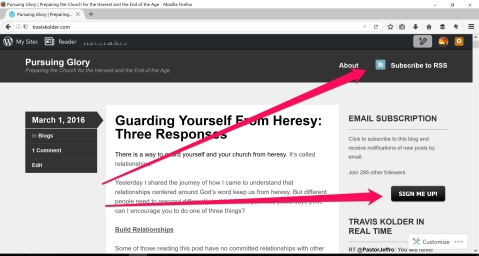
One of the rules of the internet is you can’t be everywhere…or more accurately, if you try to be everywhere, you’ll suck in many places where you are. So, you may notice that I’m not on things like Kik, Pearch, etc. If I can figure out SnapChat, I might start doing something there. Don’t hold your breath.
Okay. Now, go connect you silly humans. Ready, set, go!
Guarding Yourself From Heresy: Three Responses
There is a way to guard yourself and your church from heresy. It’s called relationships.
Yesterday I shared the journey of how I came to understand that relationships centered around God’s word keep us from heresy. But different people need to respond differently to this idea. If you read yesterdays post, can I encourage you to do one of three things?
Build Relationships
Some of those reading this post have no committed relationships with other believers. As my two year old daughter would say, “This is a problem.” You may be smart or well educated in the historical beliefs of the church, but I guarantee that if you aren’t in relationship with believers, you are opening yourself up to error, the least of which is pride.
It’s become quite popular lately to say that you can be a Christian and not go to a particular church, be a Christian and attend church on-line, or be a Christian and attend no church at all. But none of these will save your life from falling into error. Frankly, for relationships to preserve you and your church from error, you and those you care for must meet with other believers in groups small enough for others in the group to know you. And I mean *really* know you.
So, if you want to build in a firewall of relationships that protect you from heresy, begin to meet and build relationships with a small group of believers submitted to Jesus and His word. Let them know you. Get to know them. This is step #1.
Leave Hierarchy
After building relationships, it’s important to purge hierarchy from them. This may sound even stranger than “relationships protect you from error.” The truth is one major source of deception in the body of Christ is our constant appeal to something else other than God’s word. When a believer who is considered a leader believes a lie or practices sin, that believer, left unchallenged becomes a source for others to appeal to. He or she goes from a person caught in error to a source to be appealed to. “I can do it because Pastor X says it’s okay,” is the lie we tell ourselves.
Instead, regularly gather under the leadership of Jesus and in submission to Him and His word. Don’t appeal to another’s authority. Appeal to the authority of Jesus and the Bible. All of the areas essential to life and godliness are covered in the Bible, leaving little need to appeal to another believer. Your testimony and opinion are great, but they’ll never rival the message of God, which is living, active, and able to separate between soul and spirit. I have fundamental concerns about any believer who is swayed by someone’s authority but not by the clear teachings of the Bible. If someone isn’t willing to listen to God’s revealed word, your persuasion or “rank” in the body won’t move them.
Learn to Encourage/Challenge/Rebuke
Finally, it’s important for believers to learn to lovingly encourage, challenge, and rebuke each other. This is difficult, particularly if you come from an environment where an authority was the final word on every subject. But the grand vision of the church in Scripture is one where believers “speak the truth in love” to one another (Ephesians 4:15).
This is the most difficult step. You, while equal in your standing before God, with humility, begin to encourage them to obey God’s word or bring to their attention where they aren’t. This will also require humility on their part as well. But it’s in this way that we achieve the mutual submission that Paul spoke of in Ephesians 5:21.
This will require of you that you learn to be patient, loving, and forgiving. Others will get it wrong. You will get it wrong. But the benefit here is well tested thoughts about God and Scripture, along with well tested lifestyles that stand strong in the face of persecution from the world. Your life isn’t perfect in your eyes but flawed in everyone else’s. You know what you believe because it was formed in the crucible of committed relationships.
Conclusion
None of these steps are easy. They all take time and intentionality. But if you build these three realities into your life and the life of the churches you are part of, the result will be a stronger lives in the Kingdom of God.
Cluster Map

 Pursuing Glory