Saint Patrick, Shamrock Shakes, and Missional Living
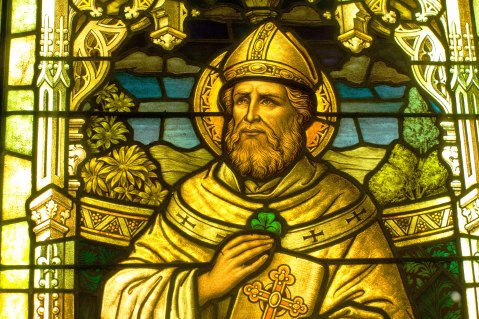
I’m not quite sure what got into me a couple of years ago. But sometime in early March three or four years ago I became frustrated with our culture’s celebration of St. Patrick’s Day.
If you think about it, it doesn’t make much sense. We take the date that perhaps one of the greatest apostolic missionaries since Paul died as a day to pinch people who don’t wear green and drink green beer. Even in Christian circles, we talk a good game about Patrick on his famous day, but we don’t do what he did.
So in my typical rebellious approach, I thought I would do something different. Instead of celebrating all things Irish on March 17th, I would spend some time getting acquainted with Saint Patrick’s life. Pretty quickly I found out that Patrick himself actually wrote two letters that we still possess and one of them is him telling the story of how God lead him to plant churches among the Irish.
But I couldn’t just read the Confessions of St. Patrick on St. Patrick’s day. No, no, no…that would be too easy. So instead, I went down to the McDonald’s in my neighborhood and read St. Patrick’s confession there…all while enjoying one of McDonald’s Shamrock shakes. Why would I do this? Because I became convinced after reading Patrick’s letters that if he lived today in my city, he would reach the people who hang out in the roughest McDonald’s in town. Something about reading the letter there stirs me to follow in Patrick’s example.
Now here’s the million dollar question: Why am I telling you this story?
The answer is this: I’d like you to join me on March 17th in reading the Confessions of St. Patrick. It’s the story of a young boy who is sold into slavery and while a slave learns how to pray to God and hear His voice. God then leads him out of slavery and back to his home, only to be stirred by God with love for his previous captors. He returns and lives like them in order to reach them and proclaim the Gospel to them. When I think of the nature of a missional lifestyle, it’s hard to get better than that. You can get a copy of his “Confessions” for free here.
But I don’t just want you to read the Confessions of St. Patrick in your home. I want you to go and read it in a place that St. Patrick would go as a missionary if he lived in your city. If you’re in my city, you can message me on Facebook and we can stage a sit-in and read it together. But ask the Lord to do in you what he has done in generation after generation and raise up missionaries for the Gospel who will love God, learn to pray, and become vessels of redemption to those living in the darkest places. You won’t regret it.
And check back here on March 17th for some thoughts from my reading of St. Patrick.
Photo Credit: Saint Patrick by Thad Zajdowicz
…We Invite Existing Believers to Lay Down Their Lives…

Recently I wrote about how we meet with existing believers when they express interest in joining our house church. Today I want to talk about one other conversation that we have in that process. We also ask existing believers to count the cost of joining a house church.
The immediate question is why would we do that?
Well, the best answer is always because Jesus asked us to count the cost of following Him, especially in regards to the cost of following Him on His mission (see Luke 14:28-30). This isn’t only a requirement for joining a house church, or our house churches, this is something Jesus asks all of us to do.
However, I’ve found it wise to invite believers to consider the cost of joining our house churches. Part of the reason is the cost of living on mission in our house churches can be higher than you would expect in a traditional church. I tell them stories about the lost people who have damaged things in our homes. I talk to them about the different times we’ve served friends in high crime areas where the potential to be harmed is real. I talk to them about the scary moments when fights have almost broke out at some of our gatherings. Certainly we try to be wise with what we do, but there’s a measure of mission that can never be controlled. So we ask folks to count the cost.
But there is another type cost that I invite existing believers to consider. It’s the cost of laying down a controlled church environment. I try to let them know that being part of an organic church means that everyone is responsible to bring what the Lord has given them, but sometimes that doesn’t work out and a meeting is bad. I share about the fact that we allow the kids to participate in a meeting with us and that means a lot more interrupted everything. I share about how community won’t just happen in a meeting, but will require us to rearrange our schedule to make time for the kind of relationships house churches have the potential to provide. Everyone says they want real community, but some like the rich young ruler have found the cost too high and walked away.
Is all of this worth it? Of course! Jesus is amazing and just knowing Him is worth all of the cost described above and more. Add on top of that the ability to get to be part of His body and stand side by side with brothers and sisters who love you and are committed to you? That’s easily worth any price we have to pay. But Jesus still asks us to consider it.
And so when we meet with believers who are interested, I invite them to think about the cost. Not because they’ve never considered the cost of following Jesus before, but because I want them to consider the cost of doing it a different way than they may have done before. All of this is done out of a heart to help, mind you. I don’t want to scare anyone away or needlessly critique someone. Over the years, this just seems to be the best way to help outsiders into the life we’ve found. It’s not for everyone, but it’s worked for us.
So, I’ll leave you with this. Regardless of where you are or what type of church you are part of, there is a cost to following Christ. Are you counting it? And are you helping others to join Jesus on His mission regardless of the cost they may have to pay? It’s worth considering.
Becoming Missional by the Power of the Spirit

Disclaimer: If you ever see a footnote on the bottom of a post, it’s likely to become a follow up post at some point. This post originated here.
There is a giant market in Christianity in the West for all things “missional.” In fact it’s so large, we’ve started naming things missional that aren’t. And much of the missional conversation has begun to center around doing good works for our neighbor–caring for the sick, empowering the poor, advocating for those at the margins.
All of this must include sharing the gospel. The missional movement will go completely off track if it abandons the story of Jesus as the way to the Father and the only answer for the human condition. In fact, while good works are important and cannot be ignored, sharing the good news must take priority in our lives. I say this as someone who has taken in people without homes and cared for the fatherless. Only the Gospel of Jesus ultimately saves people.
Our model for all of this should be Jesus Himself. He sets the terms and conditions for how Christianity should be lived out and demonstrated on the Earth. We should be surprised, then, to find that much of the missional movement not participating in the power of the Holy Spirit and advocating for a display of His power, because Jesus regularly relied on the Holy Spirit to sustain His mission.
Hear me on this: I’m sure Jesus would welcome us caring for the poor. I’m sure Jesus would encourage us for extending love to those who seem outside of the social norm. I’m sure Jesus would encourage us to care for the sick. I just see Him do it in the Gospels in a radically different manner than the missional church in the West.
A few examples of this:
After being tempted in the wilderness for 40 days by the devil, Jesus returns to Nazareth and preaches in a synagogue. He teaches from Isaiah 62, proclaiming His intent to bring good news to the poor, proclaim release to captives, open the eyes of the blind, and loose the oppressed. After being chased out of the hometown for not doing many miracles, he moves on to Capernaum where He sets a captive free by casting a demon out of a demonized man (Luke 4:14-37). There aren’t many in the missional movement I hear practicing freeing people in this way.
Jesus frequently emphasized caring for the sick. But we don’t see Jesus establishing hospitals*. What we do see is Jesus healing Peter’s mother-in-law (Matthew 8:14-17), a paralyzed man (Mark 2:1-12), and a man born blind (John 9:1-6). These are just some of many healing miracles that were the method Jesus used to “care for the sick,” (John 21:25). I hear many advocating for better healthcare in the missional movement, but very few people praying for healing.
Jesus also did a number of other miracles for the benefit of others. He fed those without food. He did this twice through miracles of multiplication (Matthew 14:13-21, Matthew 15:32-39). This is rarely how I hear missional people speak of feeding the hungry. And I hear very few answers from the missional crowd about how to deal with demonized men who live as outcasts that no one knows how to deal with. But Jesus ends both the oppression and the isolation by rebuking the demonic presence and freeing the man (Mark 5:1-20).
Jesus did all of these signs as proof that He was truly the embodiment of God’s Kingdom (John 2:23, John 6:2, John 15:24). And He did these miracles, not because He was God incarnate, but because He relied on the power of the Holy Spirit (see perhaps my favorite missional verses of all time, Phillipians 2:6-8, and John 5:19 & Matthew 12:28).
Not only did Jesus rely on the power of the Holy Spirit to be on mission Himself, He told us to do the same. He said that those who believed in Him would do not only the works He did, but greater works (John 14:12). And he commanded the apostles not to begin attempting the mission until the Holy Spirit came and gave them power to do the mission, too (Luke 24:49, Acts 1:4-5). Once this happened, they embarked on a very similar story as Jesus did.
My point in bringing all this up is that we often try to carry out the commands of Jesus in the power of the flesh. And while I’m sure there are true and real times Jesus has asked us to bandage a wound, be a friend to the lonely, and be an advocate for the poor, I want us to remember that the Jesus of the Bible had a radical, powerful trust in the Holy Spirit to deal with the true ills of society, not just manage the side affects. He brought the resources of Heaven to bare on the problems of Earth, not just the efforts of men.
The only mission we are called to is the one Jesus started. We aren’t to bring just our resources to bear on the world’s problems. We’re to draw on the Holy Spirit to truly heal the evil around us. If we want to engage in the true mission of Jesus, I think we need that same radical, powerful trust in the Holy Spirit Jesus had.
But the choice is ours: Will we do mission our way, or Jesus’?
*This is not a critique on hospitals nor me advocating not going to doctors. It’s purely a statement of fact.
Cluster Map

 Pursuing Glory