The Bible on a Deserted Island Test

This is a follow up to yesterday’s post.
Here’s a quick test to know if your expression of church is too complicated to multiply disciples. It’s called the “Bible on a Deserted Island Test.”
Imagine you crash on a deserted island and all you have is the clothes on your back and a Bible. You are stranded on the island and separated from civilized society. But the island is large enough to support several indigenous tribes of people. You are over time adopted by one of the local tribes and learn their language. Because they’ve adopted you, you now care about these people and want to share the Gospel with them.
Now, the million dollar question: Can you plant a church like you’re currently part of among them? Follow up question: Will they read the Bible and see the church you start in the pages of the Bible you have? Or do they have to have explanation of church history or your denomination?
If the answer to both of these questions is yes, congratulations! You have a simple, reproducible church. If the answer to either of these questions are no, I would invite you to consider what part of your church model might be baggage that slows the spread of the Gospel.
If your goal is to disciple the nations, your model of church should work anywhere.
Photo Credit: Into the Promised Land, Joshua 18, Abandoned Bible, White Oak Bayou, Houston, Texas 0420091320BW by Patrick Feller
A (Mostly) Made Up Story I Told My Kids
Once upon a time many, many years ago, there was a little girl who picked up a white ball with black spots and started playing with it. She decided to try making a game where you couldn’t use your hands. So she started kicking it around and soon other kids started playing. Quickly a game was created and this young lady named the game soccer.
Soon soccer games started popping up everywhere. To help soccer spread as far and wide as possible, the young lady wrote down how to play soccer in a book called “How to Play Soccer.” With the rules of soccer written down, soon the young lady was forgotten, but soccer became an international phenomenon. Everyone was playing!
“How to Play Soccer” was also an international success. Copies of the book were being sold as fast as they could be printed. Everyone who loved soccer was given a copy. As generations passed, parents would pass their copies down to their children. It became uncommon for someone not to have a copy sitting around in a drawer or a closet.
But as generations passed, people read the book less and less. And a few hundred years after the publication of the book, small changes started taking place. First, people decided that hands were okay to use. Years passed. A group of people decided that goals were unnecessary, so they were removed and the practice spread. Soon the game had evolved into people passing the ball back and forth, declaring they had scored whenever they felt like it.
Interest in the game waned. People played it because their parents did or because their parents expected them too. Some people played out a sense of preserving their cultural heritage, but the passion for the game was largely absent. Duty had replaced the love of the game.
Then, one day, something happened that changed everything. Two young boys were going on a cruise and their parents had given them a copy of “How To Play Soccer” and a soccer ball. A freak accident happened on the ship and these two boys with their book and ball ended up on a life raft that landed on a deserted island.
Obviously, survival was a primary concern for awhile, but after figuring out how to survive, they were left with little to do. The boys eventually got around to reading the book their parents had given them. Having never really played the game, they read the instructions with a fresh set of eyes. No one was around to tell them that soccer isn’t played like the book stated. And so they played. They fashioned makeshift goals and started, kicking competing against each other. They would spend weeks learning to play against each other.
Then, a miracle happened and the boys were discovered by a passing ship. They were brought back to their home city and reunited with their family. Something strange happened, though, when they returned. They played a different game than everyone else, the one they had learned from reading the book “How To Play Soccer.”
Because they had read the book and did what it said, at first they were ridiculed for playing such a strange game. Others questioned whether it was helpful or relevant to play the game like it was described in the book. But the curious and those who would have never touched soccer before suddenly began to see the fun and the joy of the game. And soon the joy of playing soccer began to spread again, replacing the formalism and tradition of the game it had become.
Soccer became fun again. It was played the way it was always intended thanks to two young boys who had the audacity to believe the book and put it into practice.
Let the reader understand….
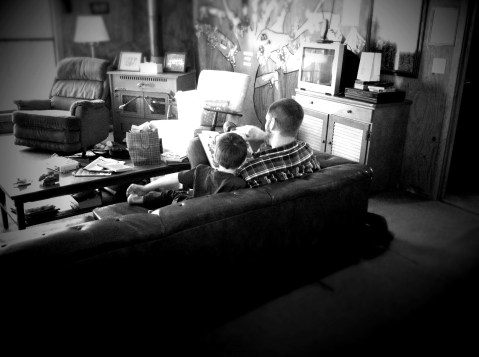
Photo Credit: Story Time (B&W) by Meredith Stewart
Have We Made Discipleship Too Complicated?

Discipleship (as it was designed by Jesus) was meant to be passed on. Each of us, regardless of our spiritual status were designed to grow into spiritual fathers and mothers who encourage and raise other spiritual sons and daughters. But often we don’t because we think discipleship is more complicated than it needs to be.
In order for the Gospel to move from generation to generation, from house to house, or from person to person, it needs to be a simple message and an encounter with a person: Jesus Christ. Think of the church in China, or the church in India, or the church in the Middle East. Without seminaries, Sunday schools, buildings, and in some cases without even Bibles the Gospel has spread to more people than our Western minds can get our heads around.
Our complaint about growth like this is that these people can’t truly be real disciples. In order for this kind of gospel explosion to take place, surely the people can’t have deep walks with Jesus!
I would challenge that assumption. These people preach the Gospel of Jesus Christ, taught to them by others. In these places, the act of being baptized can be a death sentence, not to mention sharing the Gospel and teaching others to obey Jesus. Many of them consider their time in prison to be a seminary of sorts, where they learn lessons from Jesus. These same people are constantly spreading the Gospel and raising up new disciples. Many have seen miraculous healing and heard God’s voice clearly. This certainly sounds deep to me.
Often what we mean by deep is a type of discipleship that is focused on our minds. We feel like if we are educated, we will disciple people better. We’ve even created programs that saddle our fieriest believers with large amounts of debt in order to learn how to be good leaders. For those who don’t go to seminary, we often provide long hours of training before we release them into “ministry.” This approach often slows the spread of the Gospel.
Friends, this is different than the model Jesus gave us. Jesus didn’t say go into all the world and teach people Greek and Hebrew. He didn’t sit down and have a systematic theology class with His disciples before He sent them out. He was looking for men whose hearts had been wrecked by the goodness of the Father and the Kingdom of God. When He had enough of them, He taught them simple stories that illustrated truth and asked them to pass that Gospel on. He wasn’t afraid to give these men the clear truth and let them run with it.
The Word of God is like a lion. You don’t have to defend a lion. All you have to do is let the lion loose, and the lion will defend itself.
– Charles Spurgeon
Our discipleship has to be able to work with only a Bible and a willing heart. We should be able to teach others how to follow Christ by our example and by teaching them how to read and apply God’s word. This not only spreads rapidly but if done well will create the kind of believers that make disciples who make disciples.
Often, our responsibility is to not let things get too complicated. If we can do that, the Gospel will spread further than we can possibly imagine.
For more on discipleship, check out these posts:
Redefining Spirituality: Seven Benchmarks for a Discipling Culture
On Discipleship: Nurturing Relationships
Cluster Map

 Pursuing Glory