Guarding Yourself From Heresy: Three Responses
There is a way to guard yourself and your church from heresy. It’s called relationships.
Yesterday I shared the journey of how I came to understand that relationships centered around God’s word keep us from heresy. But different people need to respond differently to this idea. If you read yesterdays post, can I encourage you to do one of three things?
Build Relationships
Some of those reading this post have no committed relationships with other believers. As my two year old daughter would say, “This is a problem.” You may be smart or well educated in the historical beliefs of the church, but I guarantee that if you aren’t in relationship with believers, you are opening yourself up to error, the least of which is pride.
It’s become quite popular lately to say that you can be a Christian and not go to a particular church, be a Christian and attend church on-line, or be a Christian and attend no church at all. But none of these will save your life from falling into error. Frankly, for relationships to preserve you and your church from error, you and those you care for must meet with other believers in groups small enough for others in the group to know you. And I mean *really* know you.
So, if you want to build in a firewall of relationships that protect you from heresy, begin to meet and build relationships with a small group of believers submitted to Jesus and His word. Let them know you. Get to know them. This is step #1.
Leave Hierarchy
After building relationships, it’s important to purge hierarchy from them. This may sound even stranger than “relationships protect you from error.” The truth is one major source of deception in the body of Christ is our constant appeal to something else other than God’s word. When a believer who is considered a leader believes a lie or practices sin, that believer, left unchallenged becomes a source for others to appeal to. He or she goes from a person caught in error to a source to be appealed to. “I can do it because Pastor X says it’s okay,” is the lie we tell ourselves.
Instead, regularly gather under the leadership of Jesus and in submission to Him and His word. Don’t appeal to another’s authority. Appeal to the authority of Jesus and the Bible. All of the areas essential to life and godliness are covered in the Bible, leaving little need to appeal to another believer. Your testimony and opinion are great, but they’ll never rival the message of God, which is living, active, and able to separate between soul and spirit. I have fundamental concerns about any believer who is swayed by someone’s authority but not by the clear teachings of the Bible. If someone isn’t willing to listen to God’s revealed word, your persuasion or “rank” in the body won’t move them.
Learn to Encourage/Challenge/Rebuke
Finally, it’s important for believers to learn to lovingly encourage, challenge, and rebuke each other. This is difficult, particularly if you come from an environment where an authority was the final word on every subject. But the grand vision of the church in Scripture is one where believers “speak the truth in love” to one another (Ephesians 4:15).
This is the most difficult step. You, while equal in your standing before God, with humility, begin to encourage them to obey God’s word or bring to their attention where they aren’t. This will also require humility on their part as well. But it’s in this way that we achieve the mutual submission that Paul spoke of in Ephesians 5:21.
This will require of you that you learn to be patient, loving, and forgiving. Others will get it wrong. You will get it wrong. But the benefit here is well tested thoughts about God and Scripture, along with well tested lifestyles that stand strong in the face of persecution from the world. Your life isn’t perfect in your eyes but flawed in everyone else’s. You know what you believe because it was formed in the crucible of committed relationships.
Conclusion
None of these steps are easy. They all take time and intentionality. But if you build these three realities into your life and the life of the churches you are part of, the result will be a stronger lives in the Kingdom of God.
How to Protect Yourself (And Your Church) From Heresy
Heresy.
It’s the great fear of churches of all sizes and stripes. It’s particularly feared whenever you talk much about releasing the church to be the church in small, relationally focused groups (house churches).
Who will protect the people from heresy? What if someone believes something that isn’t in the Bible and starts teaching it to others? To those who have grown up under a strong biblical teacher or someone who has watched someone go into error, this is enough to scare people away.
Our house church network has had to deal with this issue over and over again. Small groups of Christians meeting together where anyone can share are prime places for people with weird views to show up. Heretics, both of the doctrinal and lifestyle varieties1 have tried to insert themselves into what we’re doing. But in the nine years that we’ve been doing this one thing has consistently guarded us against heresy: relationships.
That may sound weird if you’ve never been part of a relationship-centric church. But over and over again I’ve watched as deep, abiding relationships around the word of God have rescued others from biblical error. Whenever a heresy has sprung up, it was dealt with not through authority and bible-beating, but friendships where one person has lovingly challenged another about a particular belief not being in the word of God.
We’ve also noticed that the number one indicator of someone who comes into our fellowship having the potential to be a problem has been whether or not they are in relationship with others. Those who come as believers in Jesus but have terrible relationships with other parts of the body of Christ (by their own admission) have over time shown that they are after their own interests, not Christ’s. Again it comes back to relationship. Having a healthy relationship with Christ necessitates having a healthy relationship to his body.
The crazy thing is Jesus and the apostles believed in this relational element to the truth. Jesus says, “Anyone who receives you receives me…” (Matthew 10:40). John, the Apostle, says, “These people left our churches, but they never really belonged with us; otherwise they would have stayed with us. When they left, it proved that they did not belong with us,” (1 John 2:18-19). I could go on.
The point is real, biblical truth is designed to flourish in community, not in isolation. And more importantly, real, biblical community is designed to protect the truth of Christ in the hearts and lives of His followers. Do you want to protect yourself or your church from heresy? Enter in to true relationships around God’s word.
1 I’m indebted to Neil Cole for pointing out that there are two types of heresy which the New Testament speaks of. When we speak of heresy, we usually refer to heresy of doctrine, which is obviously important to avoid. But the New Testament speaks equally about heresy of the life, where we live a life of error that doesn’t point to Jesus. While both doctrinal and lifestyle heresy are common, our discussion of heresy tends to focus on doctrinal heresy (i.e. believing Jesus is the Son of God, understanding how a man can be saved, what is the role of the Holy Spirit) while ignoring lifestyle heresy’s such as greed, legalism, or adultery. I believe Jesus is concerned with both doctrine and practice and to a certain extent, our practice is our doctrine (see Titus 2:1-13).
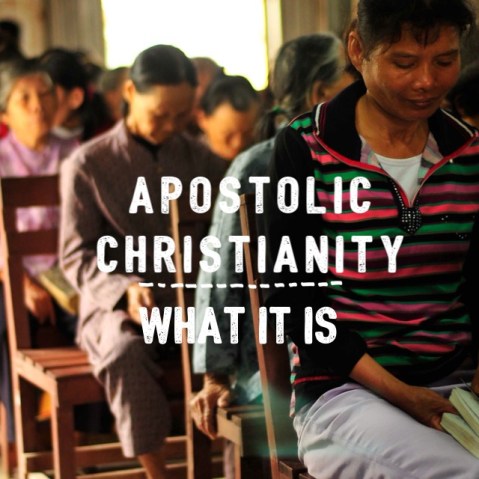
[Editor’s Note: This is Part Three of a Four Part Series addressing the nature of Apostolic Christianity. You can read the previous posts here and here.]
One of the key misunderstandings I think most people will have with the term “apostolic Christianity” is that their mind will immediately jump to those people who consider themselves apostles. Now, I not only believe this gift operates in the body of Christ, I have a high value for people who are legitimate apostles. They are a necessary part of seeing apostolic Christianity lived out on the planet. But when I describe apostolic Christianity, instead of describing one segment of the body of Christ’s gifting, I’m actually describing something I believe God will allow the whole church to walk in.
At this point, if you’re following along closely, you’re probably ready to accuse me of forcing a specific gifting on the wider body of Christ. But my goal is not to make everyone in the church an apostle, but for us to embody the same spirit of surrender to Christ’s leading that the early church experienced. The bishops of the church in the third century expressed it this way: “We believe in one, holy, catholic and apostolic church.”
You see, the whole church (that’s what that whole catholic thing means, universal) was meant to live together in a way that was handed down from the apostles themselves. Why the apostles? They were the ones Jesus himself charged with taking the Gospel all over the Earth. They were believed to have the most accurate testimony of His life and the most capable of understanding His Kingdom. And these guys gave their lives for the message of the Kingdom in the same way that Jesus had. They were good examples to follow.
So what does it mean for the whole church (not just those gifted as apostles) to embrace the lifestyle of apostolic Christianity? I’m so glad you asked! Let me give you a couple of high-level benchmarks of apostolic Christianity, fleshed out in the life of the church:
- Jesus is Lord: This could easily be described as the Church’s earliest doctrinal statement, but it is so much more than a mere doctrine. For those who are living out apostolic Christianity, this is a way of life. This starts at a very personalized, individual level. We all have to come to value Jesus as the pearl of great price, worth losing our lives over. This reality changes everything about us and we begin to live a new life, the life of Jesus. The realities of the Sermon on the Mount become the code of ethic for the individual. As we come to this recognition individually, it changes how we relate to one another. Jesus becomes what brings us together and we as a family respond to His leadership. (Romans 10:9)
- The Power of the Lord is Manifested: The constant dependence on Jesus showing up and healing, leading through dreams and visions, and casting out of demons was the norm for the early church, beyond the completion of the New Testament. It’s also a common sign whenever the true apostolic church begins to emerge through various renewal movements. More and more churches are shifting and becoming more open to the power of the Holy Spirit, but more so in theory than in actual practice. They believe Jesus does miraculous things today through people, but they don’t seek to move in the spiritual gifts. Paul strongly encouraged believers to seek these gifts out, especially prophesy, because he knew it was essential to living out the lordship of Jesus. The church that is living out apostolic Christianity not only seeks the miraculous power of Jesus, but sees it happen in its midst. (1 Corinthians 14)
- The Harvest is Plentiful: Jesus clearly intended us to believe there was an abundant harvest waiting for the church. He taught that the harvest was so abundant that it’s only limiting factor was the number of workers. Paul actually believed Jesus in this regard and was constantly moving from one place to the next, training up workers who would train other workers. Wherever we see apostolic Christianity emerging, we see the church focused on reaching this plentiful harvest. It causes the church to move out of buildings (and even homes!) into the streets. The Gospel begins to touch people who have never heard it or those who have been apathetic to it in the past. When the church embraces this apostolic lifestyle, the whole church engages with Christ’s mission to reach a vast harvest field and how they spend their time and energy reflect these commitments. (Matthew 9:37-38)
- The Oppression is Real: Jesus was clear, if they hate me, they are going to hate you. Wherever the church is truly operating as an apostolic reality following the ways of Jesus, it will be persecuted. The level of persecution will vary from culture to culture, from threat of physical death like we see in China and Middle Eastern nations to mild ridicule like we’ve seen in more open Western countries. Society doesn’t like change, no matter how much they use it as a slogan. Living out “Jesus as lord” threatens the grip of governors and makes us people who “turn the whole world upside down.” This will cause everyone from governments to social groups to feel threatened and persecute us in some way. But this will cause ample opportunity for the Gospel to go forth. In places like the first century church and China, it has amplified the church’s message, not drowned it out. This will only increase as the return of the Lord draws nearer. (Acts 17:2-8, 1 Peter 4:12-14)
- The Church is simple: Because the harvest is great, because the workers are few, because oppression is real, and because Jesus is Lord, the church typically becomes simpler and less programed. Regardless of what you believe about church structure, you are hard-pressed to find highly organized structures in the book of Acts. Simpler churches allowed the early church to start churches wherever the harvest was being gathered. I’ll say more on this in my next post “Why House Churches are Apostolic.” But for now, let me just mention that when Paul spoke of the church, he spoke of a church that was relational, connected, met primarily in homes, enabled every believer present to function in their gifts, and was able to effectively care for one another. In my view, this required simpler, more reproducible forms of organizing themselves. (Ephesians 4:11-16, Romans 16:1-16, 1 Corinthians 14)
- The Return of the Lord is Clear: Followers of Jesus function best when they believe that Jesus is coming back soon. Now, we’ve all met the guy that lives in a bunker and is storing food and guns away to resist the Anti-Christ. But this is not the kind of end-time view I’m advocating. The church that Jesus started believed He was coming back quickly. It didn’t cause them to hoard stuff, it caused them to give themselves to spreading the gospel to the darkest places on the planet. When we believe that Jesus is returning and that return will have real and irreversible consequences for the planet, we live differently. We actually begin to live in the way Jesus intended: with urgency. (Acts 1:6-11, Revelation 22:12)
Friends, if these things are true, they have tremendous implications for what we’re doing now. Business as usual has to change if we want to embrace the kind of life described here. If you are already doing this, awesome! Pray for us and pray that we all can go deeper in the grace you’re touching. If this isn’t you, then let’s together contend for God to release this type of Christianity in the Earth. I believe He will and it will change everything.
Cluster Map

 Pursuing Glory