On Discipleship: Nurturing Relationship

Jesus’ last command to His followers was to make disciples of all nations, teaching them to obey everything He had commanded them. Much of the church in the West is largely unaware of how to take a new follower of Jesus and teach them how to follow Him. We need to recover simple, transferable ways to disciple others. Yesterday we looked at how we’ve developed a rhythm of exposing ourselves to divine truth. But discipleship is much more than just exposing ourselves to God’s truth, it’s also building nurturing relationships.
First, let’s state the obvious. God’s desire for His church (literally His “called out ones”) is that they not be single, isolated believers. There are certain situations where Christians are alone because of circumstances beyond their control, but even in the case of missions, Jesus sends people out in groups of two. From the earliest days of humanity God said that “It is not good for the man to be alone,” (Genesis 2:18). God’s design for humanity is that they function within a community of people who love Christ and each other. This is why all over the New Testament there are “one another” commands that encourage us interact and support one another.
We practice these frequently within our house churches, but our 2&3’s have become a deeper expression of that community. As I’ve said, we meet in groups of two and three people of the same gender and practice accountability and confession with each other. To do this, we utilize a set of questions from Neil Cole’s book “Ordinary Hero.” You can see the list below:

Notice a couple of things with this list:
1) These are pretty in your face questions about what you’ve been doing. Most people cringe at the thought of talking about #2. Others think they have no need of talking about #’s 3 and 8. But we ask each other these questions to achieve a kind of intimacy that’s often not achieved without talking about these kind of issues.
2) Number 9 is intentionally left blank. It’s important to leave this list somewhat customizeable, because while it’s important to hit some universal questions, it’s important to be specific. My number 9 question for many many years has been “Have you been faithful to Jesus and the calling on your life this week?” But I’ve known many guys who change their number 9 every couple of months, depending on what the Lord is leading them into at that time. You can find a more thorough list of questions you can use in number 9 that friend of mine developed here.
3) Number 10 on the list is the time we take to discuss the what we’ve read in the word. Notice that it’s in the context of relationship and obedience, not in just a study that never amounts to any action.
4) Lastly, this could be interpreted as a list to be critical of ourselves or others. Instead, this list is a discussion starter. It’s purpose is to get us talking about the areas in our lives described here. If sin is discovered, we pray for one another. A couple of years ago I started to identify an addiction to soda when my friends asked me about #6. Through prayer, counsel, and encouragement, I was able to kick the addiction. But it was only as I talked through the question (that previously I thought did not apply to me) and became honest about my addiction with my friends that transformation happened.
Admittedly this is a process, which can feel mechanical if we let it. But it relies on the fact the truths that we are supposed to “encourage each other,” (1 Thessalonians 5:11), confess our sins to each other and pray for each other (James 5:16), and “motivate one another to good works,” (Hebrews 10:24).
What we’ve found as we’ve put this into practice is that these questions (when answered honestly) produce transparency. This transparency births intimacy. When I can be a source of grace and prayer to my brother who is struggling, we grow closer. Much of what we need to achieve transformation in our lives is transparency with another flesh and blood human and prayer that God promises will be effective. And the friendships that are formed from meeting this way last because they are built around Christ and continuing to walk with Him, not around things that fade.
This is simple rhythm has allowed us to develop nurturing relationships that build up the body and bring forth the character of Jesus. Whether you follow this pattern or not, I would encourage you to find the spirit of what’s described here and walk it out with other believers. It’s a gigantic part of discipleship that cannot be ignored.
On Making Disciples
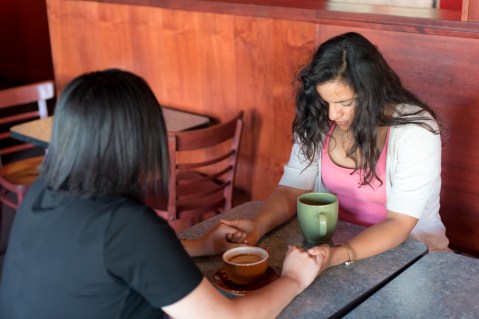
The church in the West is facing a crisis of discipleship. Every Christian should understand how to lead someone to Christ and help that person become a disciple of Jesus, but many don’t. Our over-reliance on sermons and books to transfer information has created believers that can consume information but not train others in following Christ.
As a house church planter with hopes of encouraging many others to plant house churches, I found out fairly early that this was a massive problem. After a period of time struggling with this issue, I had a number of brothers reach out to me and encourage me to read Ordinary Hero by Neil Cole. We adopted the methods found in this book over the next couple of years and we’ve seen some fantastic changes.
Before I get into the methods, though, I think it’s important to talk briefly about why we adopted a set of methods. I wholeheartedly believe that the best way to disciple another believer is life on life discipleship. Jesus invited twelve men to follow Him and be with Him, thus producing some of the most powerful disciples that we know of. This process is never meant to replace that powerful form of discipleship. But Jesus encouraged us to make disciples and every time I read the word “make” I’m reminded that there is some kind of intentionality to it. Disciples aren’t made on accident. This process is how we give intentional time and space on the calendar for what should be happening throughout the rest of the week.
Our goal was not just to make disciples,though, but to make disciples who could make other disciples. Many times a strong personality can disciple someone through solely their lifestyle, but successive generations waned after the pattern of that lifestyle was lost. We didn’t just want to pass our knowledge of following Jesus to the next generation, but set up the next generation to pass it onto several generations after us.
This required a method that was simple and reproducible. It was simple in that anyone with a Bible who could read would be able to participate and lead a group with very little training. Because of the simplicity, someone who had participated in a group for a very short time could easily take the methods and start their own group. It was reporducible. In fact, a lot of conversations I have with house church planters involves me talking through this process and emailing them the accountability questions. It’s easy to start with just a little guidance.
The process looks like this: a number of us meet in in groups of 2 or 3 of the same gender across our house church network weekly. Each of these people are reading the same 20-30 chapters of the Bible each week. They also ask each other accountability questions and pray for their lost friends and family each week. When a new believer is added to the body, they are added to the “2&3” of whomever led them to Christ. When groups grow to four people, we create two new groups of two people who continue doing the same process. It’s how we practice mutual discipleship.
We’ll look more into each of the elements of the “2&3” in the coming days. Obviously there is no silver bullet for discipleship. No process will take an unwilling saint and make him or her the next apostle to the nations. But what we’ve found is when we get believers reading their Bibles together, confessing sin to and praying for one another, and praying for those they know to come to Jesus, growth in the Lord happens naturally. This growth strengthens the churches and creates disciples who can make disciples.
Photo Credit: CoffeeShopDiscipleship-8 by 23 Images Photography

Cluster Map

 Pursuing Glory