Evangelism on the Back of a Napkin
A few weeks ago, I shared a simple question to determine if your ministry was reproducible: Does it fit on the back of a napkin?
So for the next few days, I’m going to give you a few of the truths I share on the backs of napkins, both as a challenge for me but also in hopes that they might be helpful for you.
This, for example, is the 3 Circles:
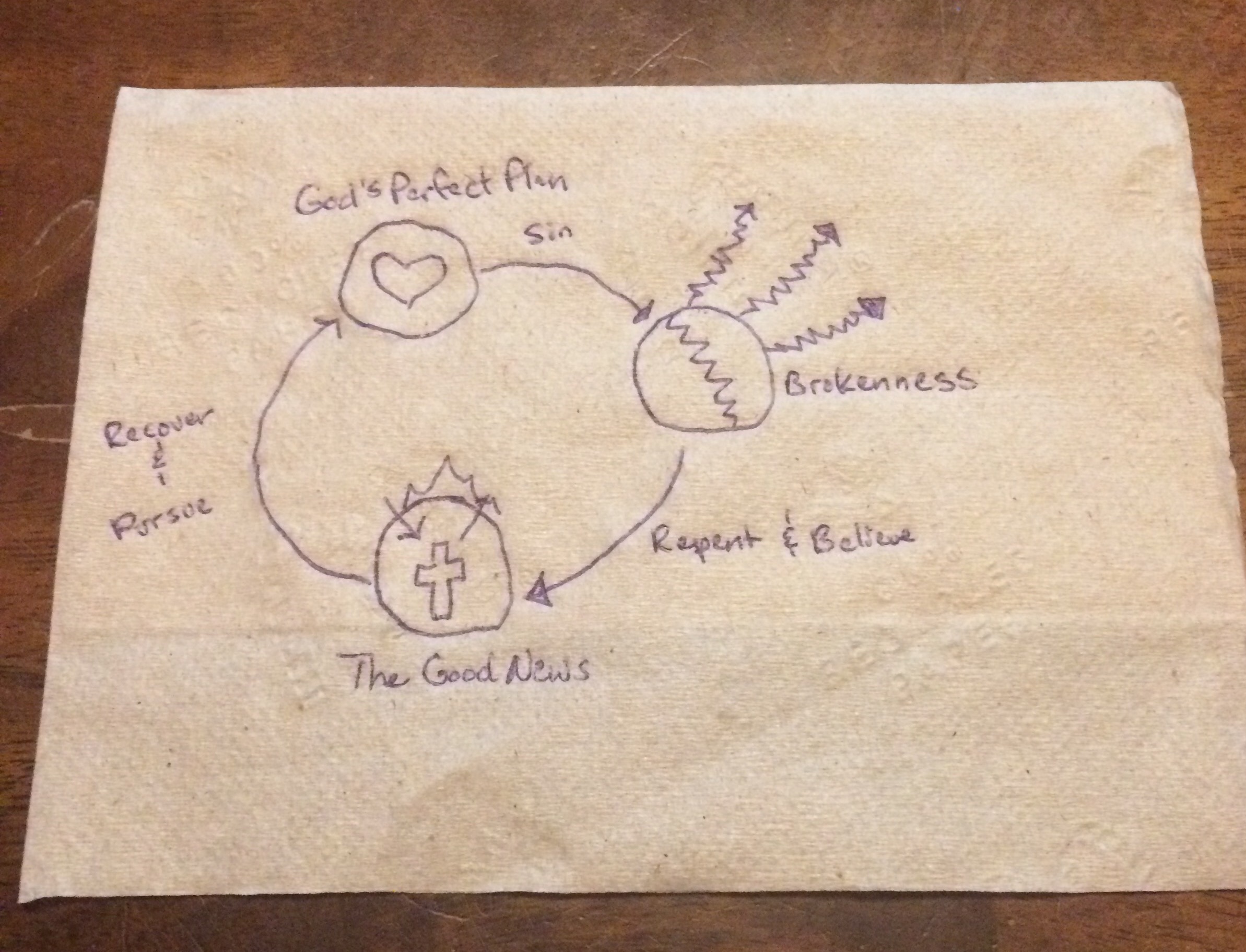
Does it cover everything from Genesis to Revelation? No. But it does hit the highlights and it’s easy to train others (even those who just came to Christ by seeing it) in how to share it.
Here’s a brief explanation:
Tomorrow, we’ll look at a napkin that will show us what to do when someone comes to Christ.
Love That is Utterly Despised

Many waters cannot quench love,
Nor can the floods drown it.
If a man would give for love
All the wealth of his house,
It would be utterly despised.
As I’ve been reading through the Song of Songs, I’ve been musing on the nature of love. But this verse caught my attention the other day and I’ve been thinking about it’s implications. Join me in thinking through what it means:
The first part of the verse is pretty easy. Love is powerful. It’s a fire that can’t be put out with water. Not even many waters can put out the fire of love–it’s that powerful.
But the second part is much more difficult. If a man gave all the wealth of his house for love, it would be utterly despised. This flies in the face of what we are taught about love, doesn’t it? Often we’re taught that love is a sacrifice, that it’s not just flowery emotions or lustful passions, but laying down our lives for one another in service. This verse seems contradictory to that idea.
Let me try and help. If a man sold all he had and attempted to buy the love of a woman, most of us would react strongly, somewhere between bored disgust and outright rage. We’d look at that man and know that he might have desire in his heart, but no real love. He was attempting to make a transaction.
Real love isn’t transactional. It’s not looking to give something in order to get something in return. It’s birthed out of a much deeper, more real place, where, yes we’re willing to give all we have, but it’s because we love whoever it is we’ve fallen in love with.
The best example is God’s love. God’s love is never transactional. We could never earn it. If we sold everything in our house and gave it to the church or the poor in order to make God love us, it would be utterly despised. We can’t buy God’s love. Nor should we want to. If we buy love, it’s not love, it’s just a transaction.
This is why it’s good news that God loved us first. The apostle John says this, “This is real love—not that we loved God, but that he loved us and sent his Son as a sacrifice to take away our sins,” (1 John 4:10). See, we cannot buy our way into this love. We can’t earn it. There is no level of righteousness that will get God to love us more than He already has. We can only receive the love of God and live lives that are a response to it.
But this is true for more than just God. We are called to love others, but often, especially within the church, we feel the need to try and win others’ love through serving. In many ways, this is giving what we have for love. It’s trying to earn love from others through our efforts or even trying to win love for God through what we do.
Now we still need to love others, but we cannot buy love through service or sacrifice. Have you ever been served by someone who you felt like didn’t love you? It doesn’t feel good. It feels forced. No one wants to feel tolerated. It’s the noisy gong and clanging symbol that Paul warns us about.
What do we do when we find we don’t love someone from the heart? We go back to God and ask Him to fill our hearts with His true love for that person. This may seem hopeless because you can do very little, but when you are convinced that God loves you in all of your weakness and mess it’s so much easier to love others who are weak and broken.
Love is stronger than death. It cannot be put out. But the fake love that doesn’t come from God will not last. Give yourself to getting the kind of love that will stand the test of time and overcome death.
You won’t regret it.
Church Starts In the Harvest

Yesterday I saw a new book by an author I follow hit the internet. Just seeing the book stirred my heart a bit, because though I know the author to be a church planter who talks extensively about starting churches the book is entirely about sharing the good news of Jesus with those who don’t know Him.
The reason this book stirred my heart was so often we can get caught up in planting churches that we forget why we do it. Church planting in the west has become about leadership, ecclesiology, and even sometimes doctrine, but Jesus meant it to be about something more.
In fact, Jesus doesn’t send us to start churches, He sends us to be His witnesses and make disciples of all nations. Church, real church, starts here. Churches are started when a group of people over time come to Christ and commit to Him and to each other as disciples of Him. This has to be our primary focus. If it’s not, all the new churches that we plant are really just shuffling around existing believers from one church to another, with no benefit to the Kingdom.
This will require of us to spend less time thinking through church structure and leadership styles and more time thinking about how to love the lost. It will require us to leave the comfort of our living rooms or sanctuaries or wherever our churches meet and bring Jesus to the places where people are. For true movements of the Gospel to happen we have to be where the people are.
If (and it’s a big if) we can get good at that, we will start to see churches planted where they’ve never been planted before: Under bridges with homeless folks and among gang members and in the board rooms of America. These things can happen. They already are in some places in this country. We just have to start seeing the role of church planter as evangelist + disciplemaker instead of church founder and CEO.
Remember, church starts in the harvest, not in the barn.
Photo Credit: Sharing the Good News by Chris Yarzab
Cluster Map

 Pursuing Glory