How Hospitality Leads To The Spread of the Gospel

One of the things I’ve learned about sharing the gospel with people since I started planting house churches is that there are significantly better ways to lead people to Jesus than inviting them to a church service. This is true regardless of whether you attend a house church or not.
In fact, one of the best ways you can be a light and present Jesus to those you know is to invite them into your home.
I know. Your home is your castle. Or your safe space. Or you just have a mess on your floor and you don’t want people over. I get it.
But inviting people into your home is the easiest way for people to see how a Christian really lives. It allows you to be vulnerable and share possibly the most precious thing you have with someone. All of this is an opportunity to talk about Jesus.
Don’t get me wrong. You’ll still have to share the gospel. You’ll still have to call people to repent and believe in Jesus. Just the mere fact of opening your door does not remove the obligation to speak the truth of the gospel. But it does open the doors of other peoples’ hearts for you to share the gospel with them.
This is why Jesus commands people to spread the gospel by staying at a house of peace (Luke 10:5-7), why the early church met from house to house (Acts 5:42), and why Paul wrote to Timothy and told him to only appoint leaders who “enjoy having guests in [their] home,” (1 Timothy 3:2). Jesus, Peter, John, and Paul all knew the value of welcoming outsiders into a home.
Let me tell you a quick story.
Fifteen months ago my dad purchased a used basketball hoop and dropped it off in my backyard without telling me. We put it up in our driveway and didn’t think much of it. This past spring, we started noticing young boys from our neighborhood showing up and playing basketball without asking us.
We had two choices. We could chase them away or we could take the time to build relationships with these kids and see where it went. And while the latter choice would be time consuming and mean our stuff would get used more roughly, we took it.
Eventually the boys started needing water. So we had cups with each kids name on it that we’d give them. Then we’d give them simple snacks. Before you knew it, sometimes 7-10 kids were eating at our dinner table, playing video games with our kids, and listening to Bible stories with us before bed. We chose to be a place where they would feel welcome and they kept showing up.
We’ve probably shared the gospel this year more with our neighborhood than in many of our previous years. And all of it started because we welcomed some kids who we could have easily turned away.
For you, it might not be a basketball hoop in your driveway. Maybe it’s your kitchen table and a cup of coffee with a neighbor who is struggling. Maybe it’s a meal with a young family around your dinner table. Maybe its the poker table in your basement that guys from your neighborhood gather around. But I guarantee you, if you look for ways to use your home for the gospel, something will turn up.
The question is, are you willing?
It’s Not Too Late

You still have time.
There are people you know all around you that are going to be by themselves on Christmas Eve and Christmas Day. They may not have family or they may be away from home. They may not be believers: They could be atheists, Hindus, Jews, or Muslims.
Regardless, no one likes to be alone, especially when everyone else is with family and friends celebrating. And this year, probably in a way that is different from many years in the past, it’s easy for people to feel alone in our culture even if people are all around them.
So, it’s not too late. Invite an international or a friend with no family to join you as you celebrate. It will be a great chance to love and serve someone. It will also be a great chance to talk about the greatness of Jesus and the reason you celebrate.
Christmas is in two days. But you can still impact a life. Invite someone to join you.
Photo Credit: Hourglass by Nick Olejniczak
Why I Still Gather When It’s Not About The Meeting
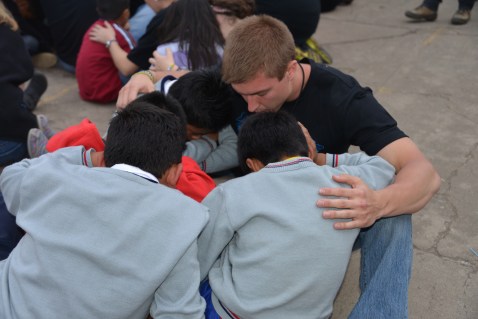 If you read yesterday’s post, squinted real hard, and didn’t ask too many questions, you probably walked away with the idea that I don’t gather regularly with a group of believers. That couldn’t be farther from the truth. But if it’s not about the meeting, why do we meet?
Some people in the movement assume that church can whimsically happen. And there is no doubt that there is a measure of serendipity when you meet another believer who feels like a long lost brother or sister. God does meet us in these moments.
But in my experience, there is something powerful that comes from having a small group of people who know me well enough to encourage me and hold me accountable. Encouragement and accountability are two elements of the Christian life that don’t happen on a whim. They are the result of sustained, long term relationships that are intentionally built.
The writer of Hebrews says it this way:
Let us think of ways to motivate one another to acts of love and good works. And let us not neglect our meeting together, as some people do, but encourage one another, especially now that the day of his return is drawing near.
Hebrews 10:24-25
Notice a couple of things here: First, we are supposed to think about ways to motivate others to good works. When was the last time you thought about a way to motivate someone you had never met to acts of love and good works? Obviously the writer is talking to people who knew one another.
The writer also calls us to “not neglect our meeting together.” There is a strong degree of intentionality here. We’re not being encouraged to randomly meet with others. We’re called to continue to meeting intentionally so we can encourage each other. The context of the need to meet together is that “the day of his return is drawing near” and, brothers and sisters, the need to gather together and encourage each other keeps compounding as the day of Jesus’ return draws closer.
Paul calls us to a very similar routine. He describes meetings in 1 Corinthians as ones that they can plan to eat beforehand if they are desperately hungry (1 Corinthains 11:22), have a true communion element to them (1 Corinthians 11:26), and are spaces and places for the gifts in the body to build up the rest of the body (1 Corinthians 14:26). None of these things happen outside of some degree of intentionality, especially with regards to the place and time of a meeting.
So brothers and sisters, we gather because we believe Jesus has gifted others in our spiritual family with other perspectives of Jesus that we don’t have. We believe these perspectives and giftings that we don’t have are essential for being built up into the image of Christ and to be strong in the face of persecution and temptation. In short, it’s by gathering with believers on purpose that we are strengthened in our walks with the Lord the way He designed.
Does this mean that you can contain the life of God in a meeting? No. But it means if we forsake gathering together intentionally with other believers, we are abandoning a main method God has given us to grow up in His image.
We become stronger when the body builds the body up. It’s the way God’s designed it. So we continue to meet.
Photo Credit: Together Prayer by David Amsler
Cluster Map

 Pursuing Glory