David, Absalom, and the Love of the Father

It’s a tragedy that’s been around for thousands of years. But every once-in-awhile God lets you see old truth through new eyes.
In short, the story goes like this: David had sinned by dealing deceitfully with Uriah the Hittite and sleeping with his wife, Bathsheba. The judgment, according to Nathan the prophet, was a sword of violence being unleashed in David’s family. This prediction begins to come true when Ammon (David’s oldest son) is killed by Abasalom (David’s third oldest son). Abasalom is banished from Israel, then restored, and once restored he begins to quietly launch a revolution to take the kingdom from David.
When the revolution happens, David is banished from his own kingdom. He takes a remnant with him and begins a war with Absalom that culminates in a final battle. It’s during this final battle that David forces his commanders to swear that if they capture Absalom they will not kill him. All of the commanders take the oath, but Joab, one of David’s most trusted commanders finds Joab hung by his hair in a tree and kills Absalom anyways.
And it’s here that our story really begins–David does what any good father would do–he weeps for his son. We see David’s heart on full display as he cries out “How I wish I had died instead of you!” Now, Joab tries to be the sensible one in all of this. He reminds David that Absalom was his enemy and that many men fought (and died) in order to restore his rule, but that matters little to David. He eventually did pull himself together and honor his army, but we see his true heart on display in his lament.
This is where God began speaking to me. I was reading this story to my sons and my daughters and I could so identify with wanting to take their place even though one of them had tried to lead a rebellion against me. “No parent should have to bury their child,” says Theoden in the Two Towers and it’s this kind of love, however misguided it may seem to others, that fills parents when they think about the demise of their children, even ones who are their enemies. As parents, it’s only right to want to die, believing our children have a better future ahead. It’s what makes us parents.
As I read the story, I began again to see the heart of God–A father who loved his children so much, that even though they participated in a horrible rebellion to overthrow His Kingdom and replace it with their own, would rather die in the place of His children than see them perish. If we feel this way…if us natural human parents feel this way towards our children…if David feels this way towards his son who sought to overthrow him, then how much more must our heavenly Father feel towards us?
Photo Credit: Absalom, Absalom! by John Lodder
Review: Misreading Scripture Through Western Eyes
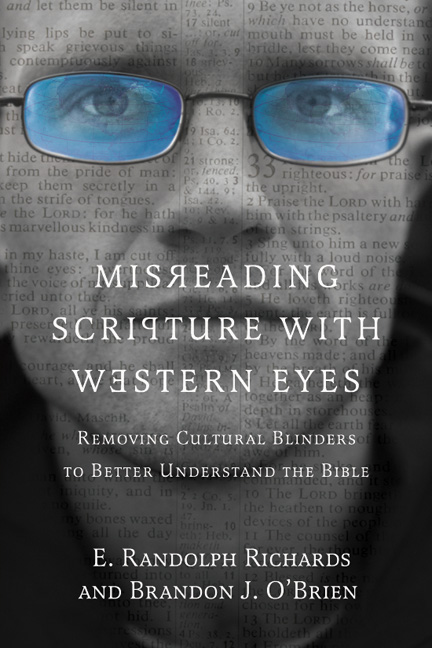
[Editor’s Note: I am slightly preoccupied this week, so I’ve asked some friends to help me keep some posts coming your way. Today’s post is a review of Misreading Scripture with Western Eyes. The review is by David Washburn.]
Randolph Richards is dean and professor of biblical studies at Palm Beach Atlantic University, and Brandon J. O’Brien, a former student of Richards, is a part-time instructor of religion at College of Du Page and editor-at-large for Leadership journal.
Together Mr. Richards and Mr. O’Brien have revealed where many Christians throughout time have mistakenly interpreted the words and actions within scripture through their cultural norms instead of the culture of the scriptural writer. As a result, those living in western societies are frequently blind to the cultural subtleties of those living in other cultures. Westerners may often miss the point of a biblical passage where the reader is expected to know something which would go without saying. For example: If I was to say, “I’m going out to eat.” It would go without saying, that I am going to go out to a restaurant. If I was in another culture or time, it would go without saying, that I was going to eat outside. Many times we assume that what we say will be understood because the reader or listener will understand what went without saying.
“The core conviction that drives this book is that some of the habits that we readers from the West (the United States, Canada, and Western Europe) bring to the Bible can blind us to interpretations that the original audience and readers in other cultures see quite naturally” (p. 15).
It is normal for readers from the West to view things with Western eyes. It is very difficult to read and perfectly understand a book which was written with an Eastern point of view, when all your life you have viewed the world from a Western viewpoint. That does not mean we can not learn to train ourselves to look for those differences. The nine differences identified in this book are written to “help us learn to read ourselves. . . . Before we can be confident we are reading the Bible accurately, we need to understand what assumptions and values we project onto the Bible: those things that go without being said and that make us assume that some interpretations are self-evident and others are impossible” (p 16)
We are all culturally immersed in our way of life. Everything we do, say and think is effected by the cultural world around us. It is easy for us to forget that The Bible was not written to people within our culture. This book helps to show us that we can not simply read our world into the Biblical world. The word of God is true and perfect. It applies to everyone worldwide, but we must also remember to view God’s Word with an eye towards the culture and times of the writer.
This is an excellent book which I highly recommend Christians to read. It will not overnight make you understand all the cultural differences within Scripture, but it is a good place to start.
 David Washburn is a follower of Jesus, a husband, a father, and a grandfather. He is an author of short stories and blogs occasionally. You can connect with David on Facebook and Twitter.
Where the Cross Meets Community

Today is Holy Saturday, the day between Good Friday and Easter Sunday. Since there’s not much to write about the day where Jesus laid in the grave, I thought I’d take today and reflect a bit on how the cross affects the life of the believer.
The cross and the resurrection began a revolution in the life of humanity. Humans, who had lived under the thumb of sin for thousands of years, finally were freed from its dominance. They could have a relationship with God! We can draw close to God in a way that was never possible. But the cross changed more than just our position before God. The cross changed how we live with one another.
Live a life filled with love, following the example of Christ. He loved us and offered himself as a sacrifice for us, a pleasing aroma to God.
-Paul, Ephesians 5:2
Paul (and the other apostles) constantly call us to not just accept the work of the cross in our life. They also call us to follow the example of Jesus in how we relate to others. Many of us will read Paul’s letter and hear a call for Christians to “be nice.” Paul points us to lay our lives down in love for one another in the same way Jesus gave up His life on the cross.
This is a whole different level than just doing good to others. Jesus’ example means giving up our lives for the betterment of others. It means entering into situations others have created for no other purpose than to love and serve them. It often means you absorb the cost for others’ actions.
I remember a time back in college when we planted our first house church. I had just gotten done taking care of all my bills with my meager college income and I had just gotten paid and had a little extra cash in my pocket for the first time. It was at this exact moment that a single mom in our house church shared a need she had. She was behind on her electric bill and needed to come up with the cash to pay it. Somehow between all of us we came up with the cash, but the lesson I learned was this: My money isn’t just my money. In order to love like Jesus, I needed to lay down my life for others. In this case it was my excess cash that I was so happy about.
Friends, Jesus didn’t owe us anything. He entered our world and paid the price of our sin because He loved us, not because we deserved it. In the same way, He calls us to follow Him into the lives of others and love them in the same way.
Today (and tomorrow, and the next day, and the next…) as we remember the price Jesus paid for our sins, commit yourself to share the kind of love you’ve received from Him with other believers in your life. Share the love you received in the same way He showed it to you.
[Update] Frequent commenter Dan left this well stated truth in the comment section:
He died once for sin but daily, moment by moment, gives Himself to us. We died once to sin, but daily, moment by moment give of ourselves to others.
Cluster Map

 Pursuing Glory