Church as Family

This morning as I was scrolling through social media, I saw one of the people that I follow talk about how modern church is like a school and it should be more like a support group (think AA). Both of these are true statements. While I agree with both parts of this statement1, I believe the pattern for church was built on something much more ancient: family.
This shouldn’t surprise us. God is a Father and a Son in relationship with each other. Jesus emphasized the brotherhood of all believers (Matthew 23:8). This wasn’t just a term of affection, but a call to really act as brothers of a family. New Testament churches were often started in the homes of men or women of peace (see Luke 10:6) who would give a church planter an audience to his or her extended family. The spirit of family within each church would be greatly aided by the fact that most of the early members were part of the same family. Paul himself saw his apostolic ministry in the context of being a parent to the churches he planted (see 1 Corinthians 4:15, 1 Thessalonians 2:7). The church functioned first and foremost as a family.
I don’t think it’s surprising to most of us that the early church acted like a family. I think what surprises many is when churches today act as family towards each other. Often we pick other organizing principles, particularly those of business and education and structure our time around production and education instead of what builds us up as family.
So how does the church act as a family together?
They love each other. This starts with spending time together in a way the builds and facilitates relationship. There is plenty of time and space for relationships to develop, trust to form, and support to be given. Many times this love is expressed through serving each other in ways that reflect how Jesus has loved us and laid His life down for us.
Commitment is seen. Often church is seen as something that can be walked away from when it becomes inconvenient. If the teaching becomes stale, I’ll look for something better. If the worship becomes out-dated, there’s a more contemporary worship gathering down the street. But when churches act like families, the members don’t bail at the first sign of conflict or the opportunity to get a better experience. They commit to the bonds of love that the Lord has called us to.
There is mutual give and take. In every family, each member fulfills a roll of some kind. Rare is the family gathering where one member of the family does all of the talking. There is a back and forth kind of conversation that happens. Not everything everyone says in a family is of equal value. There are various levels of maturity, but conversation is the main method of learning and interaction and it produces well-rounded disciples.
There is growth and reproduction. Every family that doesn’t grow and reproduce will die off. I’m part of a large extended family in the natural, helping raise the fourth generation of Kolders that have come from the line of my Grandpa and Grandma Kolder. But each generation has had to grow up, move out of mom and dad’s house, and have little Kolders of their own. The same is true for the church. Family can seem safe, but there is a responsibility in family to step out, grow up, and pass on what you’ve received as part of your family to the next generation. Churches do this when they reach the lost, make disciples, and pass on the dynamic of Christianity as family to those they are discipling.
There is a lost generation of men and women all across our country. Not only are they far away from God, but they have a hunger in their heart for something they’ve never had: family. The answer starts when a person enters into a life-transforming relationship with God as their Father. It’s fully recognized, though, when a flesh and blood spiritual family adopt this new believer as one of their own. This is the reality that drives out the orphan spirit in us once and for all. To do that, the church may need to stop acting like a school or a business and devote themselves to becoming a family once more.
Photo Credit: Family by Randen Pedersen
1Church as we know it has largely adopted a meeting style from the educational system (one person teaching, rows of students, listening-based). Support groups such as AA have much to offer the church as a means for growing their body (high accountability, high intimacy, intentional mentoring, etc.).
Bedtime Routines, the Gospel, & Discipleship
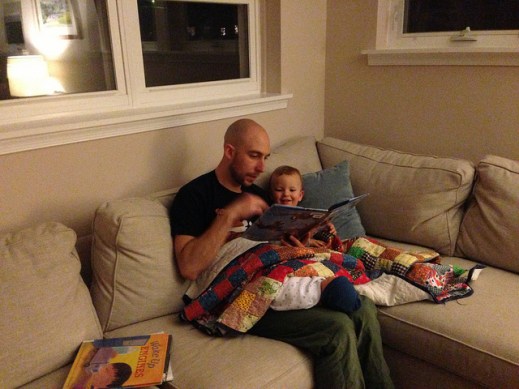
Every night we have a certain bedtime routine where we read our kids a story from the Bible, pray with them, and tuck them into bed at night. However, the last three or four months or so, my youngest has started to ask us to tell her “the Jesus things” before we tuck her in. What she means by “the Jesus things” is the story of how Jesus rescued her (and all of us) from sin and its consequences. My daughter uses this as an opportunity to stay up late. I’m using it as an opportunity to soak her soul in the Gospel.
Last night on my 97th time telling my daughter “the Jesus things” I started to realize that I was only telling her part of the Gospel. See, I told her about sin, about how she was separated from God, about how Jesus came and lived, taught, healed the sick, cast out demons, raised the dead, and taught people how to be close to God. I told her about Jesus’ death and the cruel way He was treated. I even told her about how Jesus was raised from the dead and because of that resurrection, when we receive Christ, we are transferred from the kingdom of darkness to the Kingdom of God.
What did I miss?
Last night, I realized I missed anything that happens after saying “Yes” to Jesus. You see, I had focused on the theological, evangelistic portion of the Gospel…the “sign here” kind of Gospel that you come to expect from used-car-salesmen-style evangelists. what I hadn’t told her was what to expect after that and why it was still good news.
After I realized it, I changed the last few lines of my finely honed presentation to include a couple thoughts about what that would look like. It got me thinking about how often we present the Good News to people about Christ as a decision to make that will make their life better, but we present discipleship to people as a cross to bear. While I definitely believe that there is a cross to bear in discipleship, I do not believe that Jesus is the Good-News-yin to discipleship as a bad-news-yang.
So what’s the good news in discipleship? It’s simple and its what caused the first disciples to leave their businesses, family, and comfort and face persecution and death to spread the Gospel–we get to be like Jesus. Jesus put it this way: “A pupil is not above his teacher; but everyone, after he has been fully trained, will be like his teacher,” (Luke 6:40).
That’s the good news in discipleship–that we can be like Jesus. This man who we begin to learn how to follow after coming to Him and surrendering everything, actually has a plan to make us like Him. We will grow up into all aspects of Him–His character, His power, His nature–everything Jesus was and is we get to grow into. This is the good news that keeps us saying yes to the discipleship process. It’s good news to our hearts when we’re tired and weary. Most importantly, it’s not the dreaded fine print to what had previously looked like a really good deal.
So, I told my daughter a little different Gospel. I told her when she says yes to “the Jesus things,” she gets to grow up and be like Jesus. I intend to tell those I’m discipling the same thing. My guess is they haven’t heard it from me nearly enough.
Maybe you should go back and check your Gospel, too?
Jesus Gave Up His Heavenly Life


One of the mysteries of the Christian faith is that God has always existed as Father, Son, and Holy Spirit. Since before the creation of the world, these three have existed in an exchange of love and unity so perfect that we describe “them” as one God and three persons. This love flowing back and forth from God to God is the foundation for the reality we describe as Heaven. Everything we love about the idea of Heaven is born out of the glory of the love of God being exchanged between the Father, Son, and Holy Spirit.
So when we think about Jesus and the sacrifice He made for us, we often think about the fact that He was unjustly accused, the pain He endured on the cross, the loss of His physical life, and the punishment He took on Himself for our sins. Rarely, though, do we think about the fact that Jesus made an earlier sacrifice. Jesus actually willingly laid down the life of Heaven to come to be a man. He left perfection and chose to live in a world damaged by sin and full of brokenness. He stepped outside of the tangible presence of God in order to lay down His life for us. Paul actually says that He “did not regard equality with God a thing to be grasped, but emptied Himself, taking the form of a bond-servant, and being made in the likeness of men,” (Philippians 2:6-7).
Jesus had to give up everything that made Him God in order to walk out our redemption. He had to leave the unbroken relationship with the Father He had since the beginning of time in order to come and save us. He left the comforts of Heaven for a life on Earth that would end with the most terrible death humanity had yet devised. He traded everything He had so we could know the Father.
Friends, this reality should challenge us to our very core. At it’s root, there is a radical surrender unlike anything the world has ever seen at play here, all for our good. This sacrifice caused our salvation. It purchased redemption for our world. This sacrifice wasn’t just to save us though, Paul also uses this picture of Jesus laying down the privilege of being God as an example of what we are to do: “Have this attitude in yourselves.”
We are to lay down our lives the same way Jesus laid down His. Not just by suffering a painful death on the cross, but by leaving behind our privilege for the sake of others. Nowhere is this message more needed than in the West. We have become, for all intents and purposes the most comfortable generation in the history of mankind. And yet, though we have more comfort, more ease, and even more ability than generations past, we seem to struggle with sharing the Gospel and leading people to Jesus. We believe this is because of the hardness of our hearts, the wealth or wisdom of the population, or the fact that our culture is just tired of Christianity.
Maybe.
But what if the problem is at least in part that we’re not willing to get uncomfortable? What if as a church, we haven’t done what Jesus did? Is it possible that we haven’t been willing to embrace the radical leaving behind of the comforts of the world and the comforts of the church to bring the Gospel to places damaged by sin? Is it possible that we are making the opposite choice that Jesus did? Are we choosing the comfort of a relationship with God and God’s people, the comfort of nice things, the comfort of safety, and loosing out on a life lived among the lost helping them find their way back to God?
Friends, today, I want to challenge you. There is a radical sacrifice that Jesus made when He became a man. He laid aside His status. He embraced suffering, even to the cross and it opened up salvation for millions. Can you lay aside your status? Can you bring the Gospel to those who don’t have it? Can you embrace the suffering that comes along with that life, knowing others will come to Christ?
I don’t believe that most of the world hates Christ. I believe they’re waiting to see the life of Jesus displayed in front of them. The question is will you lay down your life like He did? Will you embrace the radical surrender of your own life for the life of Christ?
I challenge you to do it.
Photo by Josh Boot on Unsplash
Prayer Request:
Dear brothers and sisters in Christ around the country,
 Recently a friend of mine from my time in Kansas City suffered a terrible tragedy. Jason Johns, an inner city leader of a church in Kansas City, was in a terrible car accident with his three children. All four were injured, but his daughters Hope and Elise need miraculous intervention. You can read more updates on their GoFundMe page. Please pray for Jason, his wife, their family and extended family with me and believe for God’s best for this young family.
Sincerely,
Travis
Cluster Map

 Pursuing Glory