Eat the Chicken, Spit out the Bones (Part I)

We can learn from others who aren’t perfect. It’s entirely possible. In fact, it’s the only way we grow as part of the body of Christ. The problem most people have with learning from others who aren’t perfect is the idea that they’ll some how be lead into sin or deception.
Most of you know I spent some time in a Bible college almost fifteen years ago. During that time I heard Mike Bickle say over and over again one phrase that has stuck with me and helped me learn from almost everyone: “Eat the chicken, spit out the bones.”
This was revolutionary to me the first time I heard it. Prior to that, everyone I met was either a defender of truth or a heretic to be avoided. The confusing part was what to do when the defenders of the truth disagreed with each other!
This simple statement communicated so much in one simple phrase. People (believers, specifically) aren’t either all right or all wrong. They are a complicated mix of truth that can nourish you and oddball theologies and practices that you probably don’t want to try and swallow.
Deeper still, there is no chicken without bones to work past, so no matter how good the chicken, expect a few bones. The presence of bones shouldn’t cause you to forsake the chicken, either! The point is that you can read broadly, listen closely to lots of voices, and find truth that is there, without having to adopt anything unbiblical.
For example, unless you’re willing to write off about twelve hundred years of church history, almost all of the writings we have from 300 AD to 1500 AD are Catholic in nature. Now, you can ignore the writings of this time out of fear of growing in the belief that Pope is infallible and Mary is a goddess, or you can understand that these men were a complicated mixture of truth and error and learn from them where you can.
My friends in the missional movement are a tremendous encouragement to me to share the Gospel and recover much of what is missing from the church. However, I’d be lying if sometimes I didn’t see them slip into both theological and political liberalism that I don’t see in the New Testament. The beauty is I can learn from these men and women without having to wholesale adopt everything that they believe.
So read that Catholic mystic, that evangelical mega-preacher, and that missional guy who loves the poor. Just make sure that you don’t worship Mary, crowds, or liberalism instead of Jesus. In fact, I expect you to do the same thing with what I’ve written. We won’t agree on everything, but we can agree on Jesus and learn from the good in each others’ and others’ lives.
Eat the chicken, spit out the bones.
Photo Credit: I Got Bored So I Roasted a Chicken – Picture of My Dinner 09-30-08 by Alvin Smith
Review: Misreading Scripture Through Western Eyes
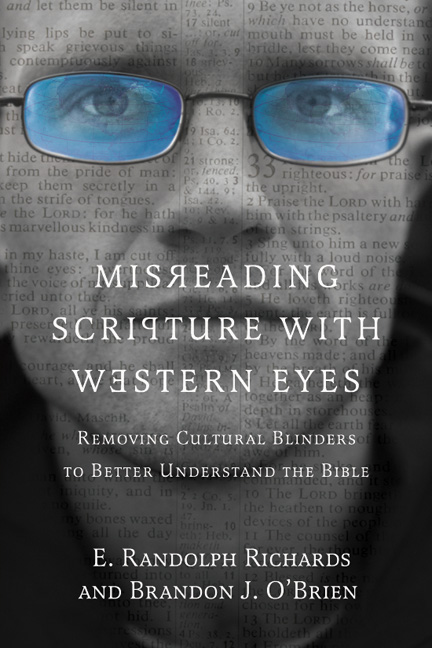
[Editor’s Note: I am slightly preoccupied this week, so I’ve asked some friends to help me keep some posts coming your way. Today’s post is a review of Misreading Scripture with Western Eyes. The review is by David Washburn.]
Randolph Richards is dean and professor of biblical studies at Palm Beach Atlantic University, and Brandon J. O’Brien, a former student of Richards, is a part-time instructor of religion at College of Du Page and editor-at-large for Leadership journal.
Together Mr. Richards and Mr. O’Brien have revealed where many Christians throughout time have mistakenly interpreted the words and actions within scripture through their cultural norms instead of the culture of the scriptural writer. As a result, those living in western societies are frequently blind to the cultural subtleties of those living in other cultures. Westerners may often miss the point of a biblical passage where the reader is expected to know something which would go without saying. For example: If I was to say, “I’m going out to eat.” It would go without saying, that I am going to go out to a restaurant. If I was in another culture or time, it would go without saying, that I was going to eat outside. Many times we assume that what we say will be understood because the reader or listener will understand what went without saying.
“The core conviction that drives this book is that some of the habits that we readers from the West (the United States, Canada, and Western Europe) bring to the Bible can blind us to interpretations that the original audience and readers in other cultures see quite naturally” (p. 15).
It is normal for readers from the West to view things with Western eyes. It is very difficult to read and perfectly understand a book which was written with an Eastern point of view, when all your life you have viewed the world from a Western viewpoint. That does not mean we can not learn to train ourselves to look for those differences. The nine differences identified in this book are written to “help us learn to read ourselves. . . . Before we can be confident we are reading the Bible accurately, we need to understand what assumptions and values we project onto the Bible: those things that go without being said and that make us assume that some interpretations are self-evident and others are impossible” (p 16)
We are all culturally immersed in our way of life. Everything we do, say and think is effected by the cultural world around us. It is easy for us to forget that The Bible was not written to people within our culture. This book helps to show us that we can not simply read our world into the Biblical world. The word of God is true and perfect. It applies to everyone worldwide, but we must also remember to view God’s Word with an eye towards the culture and times of the writer.
This is an excellent book which I highly recommend Christians to read. It will not overnight make you understand all the cultural differences within Scripture, but it is a good place to start.
 David Washburn is a follower of Jesus, a husband, a father, and a grandfather. He is an author of short stories and blogs occasionally. You can connect with David on Facebook and Twitter.
A (Mostly) Made Up Story I Told My Kids

Once upon a time many, many years ago, there was a little girl who picked up a white ball with black spots and started playing with it. She decided to try making a game where you couldn’t use your hands. So she started kicking it around and soon other kids started playing. Quickly a game was created and this young lady named the game soccer.
Soon soccer games started popping up everywhere. To help soccer spread as far and wide as possible, the young lady wrote down how to play soccer in a book called “How to Play Soccer.” With the rules of soccer written down, soon the young lady was forgotten, but soccer became an international phenomenon. Everyone was playing!
“How to Play Soccer” was also an international success. Copies of the book were being sold as fast as they could be printed. Everyone who loved soccer was given a copy. As generations passed, parents would pass their copies down to their children. It became uncommon for someone not to have a copy sitting around in a drawer or a closet.
But as generations passed, people read the book less and less. And a few hundred years after the publication of the book, small changes started taking place. First, people decided that hands were okay to use. Years passed. A group of people decided that goals were unnecessary, so they were removed and the practice spread. Soon the game had evolved into people passing the ball back and forth, declaring they had scored whenever they felt like it.
Interest in the game waned. People played it because their parents did or because their parents expected them too. Some people played out a sense of preserving their cultural heritage, but the passion for the game was largely absent. Duty had replaced the love of the game.
Then, one day, something happened that changed everything. Two young boys were going on a cruise and their parents had given them a copy of “How To Play Soccer” and a soccer ball. A freak accident happened on the ship and these two boys with their book and ball ended up on a life raft that landed on a deserted island.
Obviously, survival was a primary concern for awhile, but after figuring out how to survive, they were left with little to do. The boys eventually got around to reading the book their parents had given them. Having never really played the game, they read the instructions with a fresh set of eyes. No one was around to tell them that soccer isn’t played like the book stated. And so they played. They fashioned makeshift goals and started, kicking competing against each other. They would spend weeks learning to play against each other.
Then, a miracle happened and the boys were discovered by a passing ship. They were brought back to their home city and reunited with their family. Something strange happened, though, when they returned. They played a different game than everyone else, the one they had learned from reading the book “How To Play Soccer.”
Because they had read the book and did what it said, at first they were ridiculed for playing such a strange game. Others questioned whether it was helpful or relevant to play the game like it was described in the book. But the curious and those who would have never touched soccer before suddenly began to see the fun and the joy of the game. And soon the joy of playing soccer began to spread again, replacing the formalism and tradition of the game it had become.
Soccer became fun again. It was played the way it was always intended thanks to two young boys who had the audacity to believe the book and put it into practice.
Let the reader understand….
Photo Credit: Story Time (B&W) by Meredith Stewart
Cluster Map

 Pursuing Glory