Prophetic Insight from Bonhoeffer
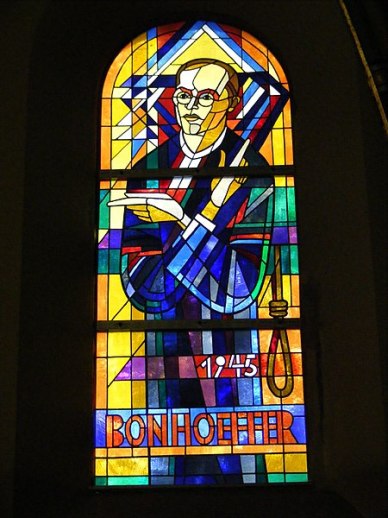
Those of you who have been around for awhile may know that I have a deep love for Dietrich Bonhoeffer, a German pastor and Nazi resistor who ultimately gave his life trying to stop Hitler and the Nazis. Bonhoeffer was a more than just a resistor, though. He understood the centrality of Christ and His Church in a way that few did in his day.
Right now I’m taking a deep dive into Bonhoeffer’s life. I think there’s a lot to learn there. Here’s a quote I ran across today:
There is a word that when a Catholic hears it kindles all his feelings of love and bliss; that stirs all the depths of his religious sensibility, from dread and awe of the Last Judgement to the sweetness of God’s presence; and that certainly awakens in him the feeling of home; the feeling that only a child has in relation to its mother, made up of gratitude, reverence and devoted love; the feeling that overcomes one when, after a long absence, one returns to one’s home, the home of one’s childhood.
And there is a word that to Protestants has the sound of something infinitely commonplace, more or less indifferent and superflous, that does not make their heart beat faster; something with which a sense of boredom is so often associated, or which at any rate does not lend wings to our religious feelings–and yet our fate is sealed if we are unable again to attach a new or perhaps very old meaning to it. Woe to us if that word does not become important to us soon again, does not become important in our lives.
Yes, the word to which I am referring is ‘Church’, the meaning of which we have forgotten and the nobility and greatness of which we propose to look at today.
Dietrich Bonehoeffer: A Biography by Eberhard Bethge, Page 42
Are we not in the same place today? Do we not need to recover the meaning of the word ‘Church’ and make it central and sacred in our lives?
Photo Credit: Dietrict Bonhoeffer Stained Glass,St Johannes Basilikum, Berlin SW29 by Sludge G
What We Can Learn from Wang Yi and the Underground Church of China

Last week I tweeted a link to the statement of imprisoned Chinese church leader Wang Yi’s church. You can read it here.
In brief, Wang Yi is the pastor of an underground church in China, Early Rain Covenant Church. Pastor Wang and 100 of his fellow believers were arrested by the Chinese government about one year ago. Now, Wang has been sentenced to nine years in prison for subversion of state power and illegal business operations.
What I love about this statement is how it emphasizes things that we wouldn’t emphasize if we are being persecuted. The statement is written by a people who know what it means to suffer and how to do it well. It’s a model for how us as Christians should handle suffering as it becomes more and more normal to suffer for Christ in the West.
Here are just a few thoughts from the letter that I think Western Christians can learn from:
- “Christians should be willing to submit to the government’s physical restrictions of them.” What’s refreshing about this take is that Christians in America often get caught in a kind of antagonism where if we are jailed or even lightly rebuked for sharing the Gospel, we want to demand our rights. The apostle Peter tells us to submit to civil authority and to bear up under the pressure of suffering, even though we’ve done nothing wrong (see 1 Peter 2:13-20).
- Pastor Wang’s arrest is part of his calling. In the West, we often take on titles and positions as an antidote to suffering. We give difficult, arduous tasks to those who are farther down the “ministry ladder” than we are. However, Pastor Wang and his church understand suffering as a normal part of his calling. 1 Peter 2:20 tells us that we are called to follow Jesus into the same type of suffering he endured. We are called to suffering, especially as a servant of the Gospel. So OF COURSE he’s suffering. He’s responded to God’s call on his life. May we understand again that our calling is not what’s written on a business card, but to literally follow the footsteps of Christ, whichi includes suffering as He did.
- No crimes were committed. In a free society, Yi would not be jailed for his actions. I find this part of the statement interesting, mostly because I believe this to be an effort of the church to earn credibility with the Chinese people and people around the world. In arguing that he has not committed a crime, the church is defending his morality and trying to earn rapport with the rest of the world. Peter tells us it’s better to keep our integrity and suffer rather than to suffer for committing and actual crime (1 Peter 3:16-17) and the church seems to be making a case that this is what happened.
- No hate, just evangelistic love. After some exhortations of the Chinese government to “stay in their lane,” the church calls on believers to pray for the salvation of the Chinese government. This is so crucial. Many would be tempted to pray down God’s judgment, but the church is following in Jesus’ steps and saying “Father, forgive them, they don’t know what they do,” (Luke 23:24). It’s this kind of heart cry that will open the hearts of unjust persecutors to the truth of the Gospel and save some of them.
Imagine this-the church in America can learn to suffer for the glory of God. We can learn to submit to government authority and still obey God. We can embrace suffering as part of our calling and maintain our integrity. We can even pray for those who persecute us to find the light and the truth. We have no better teacher in this than our brothers and sisters in China and other parts of the world.
We just need to be willing to learn from them.
Photo Credit: Person Behind Mesh Fence by Mitch Lensink on Unsplash
The Discipline of Praise

Picture yourself alongside the apostle Paul. There you are in a dark, miserable prison. Rats are plentiful. The smell of human waste is everywhere. You have no idea when you’re going to be released. You’ve been faithful to Jesus to share the good news of the gospel with many in the city of Philippi and because of that, you’ve had handcuffs slapped on your wrists and you were thrown into this prison.
Then, Paul leans over to you. You don’t necessarily expect Paul to gripe and complain, but you weren’t prepared for what he said next: “Brother, I know it’s late. I know we’ve just been beaten and the rats are starting to nip at us, but we should start praising the Lord.”
In that moment, what would your reaction be?
Now, I’m not going to sit here and tell you that I would just jump right in singing and praising God like Silas did. Your reaction to that statement tells a lot about what you believe God deserves praise for. Paul had learned something that others before Him learned: We don’t just praise God because circumstances are going well. We praise Him because of who He is.
In this way, praise is a discipline. We don’t just wake up one morning desiring to praise God in the darkest and most bitter circumstances. What’s more likely is that we begin every day to delight in God for who He is and what He’s done for us in whatever circumstance we find ourselves in. *This allows us to praise Him no matter the circumstances.*
Listen to David:
“I will rejoice and be glad in Your lovingkindness,
Because You have seen my affliction;
You have known the troubles of my soul,” (Psalm 31:7)
or
“Sing for joy in the Lord, O you righteous ones;
Praise is becoming to the upright,” (Psalm 33:1)
or
“I will bless the Lord at all times;
His praise shall continually be in my mouth,” (Psalm 34:1).
All of these point to David calling us to make a decision, based on who God is, to offer praise. None of these commands are based on the circumstances going on around him or us. In fact, some of them call us to praise in spite of the circumstances.
Beloved, we must get better at praising God for *WHO* He is, despite our circumstances. It’s the only practice that will get us to the place where we praise God in the prison. We want to be the people whose spirits are so alive with God that despite the gruesomeness around us we still love God.
We don’t get there in a minute. We get there day by day, praising God where we are at right now.
Photo Credit: Person standing on rock raising both hands by Xan Griffin on Unsplash
Cluster Map

 Pursuing Glory